

Introduction: Who Was Deborah in the Bible?
Deborah in the Bible was a prophetess and judge of Israel who served during a difficult period in the nation’s history. Her main account appears in Judges 4 and 5, where Israel was oppressed by Jabin, king of Canaan, and his commander Sisera. Deborah called Barak to lead Israel into battle, and God gave His people victory.
Her story is more than an account of an ancient battle. As one of the notable women of the Bible, Deborah appears at an important point in Israel’s history, when God brought deliverance to His people through unexpected means. This Bible study will clarify who Deborah was, what Scripture says about her role, and how Judges 4 and 5 present her place in God’s work.
Quick Facts About Deborah’S Biblical Role
| Fact | Answer |
|---|---|
| Biblical book | Judges |
| Main chapters | Judges 4 and 5 |
| Role | Prophetess and judge |
| Location | Palm of Deborah, between Ramah and Bethel |
| Husband | Lappidoth, according to Judges 4:4 |
| Military figure | Barak |
| Enemy commander | Sisera |
| King of Canaan | Jabin |
| Other woman central to the victory | Jael |
| Song | Judges 5 |
As one of the notable biblical women, Deborah’s account connects with other women whose stories reveal different ways God worked through people in Scripture. You can also explore our list of women in the Bible for related character studies.
What Does Deborah’s Name Mean?
The name Deborah comes from the Hebrew name Devorah (דְּבוֹרָה), which commonly means “bee.” It is a Hebrew name found in the Old Testament and is also used for another woman named Deborah in Genesis 35:8. The literal meaning should be kept separate from later symbolic interpretations. Scripture does not say that Deborah’s name proves anything about her character, calling, or actions.
This character study considers her name as part of her biblical identity, while her Christian faith and character are understood through what Scripture records. See also Eve and Esther for additional women of the Bible.
Deborah’s Calling as Prophetess and Judge
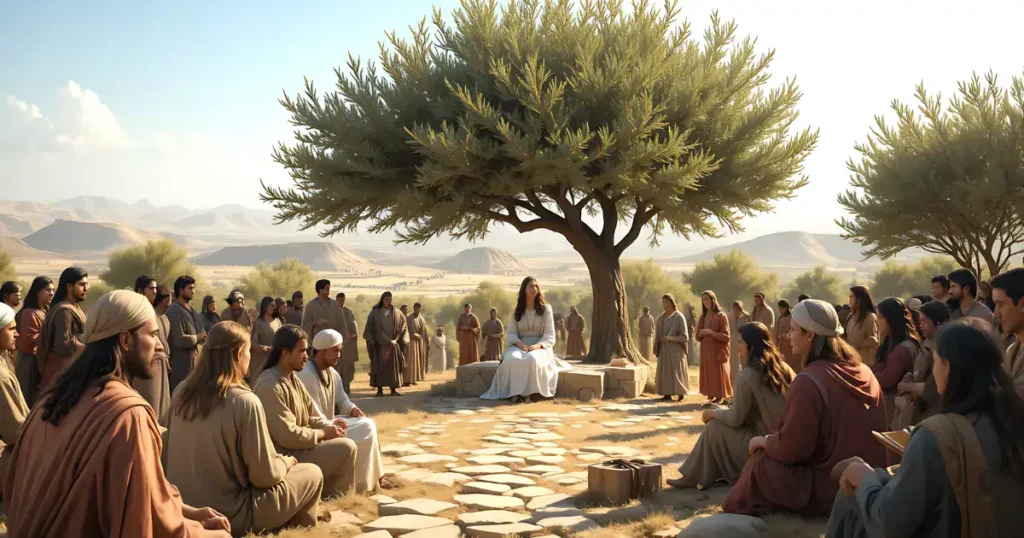
Judges 4:4 introduces Deborah as a prophetess and the wife of Lappidoth. She also served as a judge, giving her a recognized role among the people of Israel. Scripture tells us that the Israelites came to her for judgment, and she sat under the palm of Deborah between Ramah and Bethel (Judges 4:5). Her role was not simply to settle personal disputes. She also received and communicated God’s direction to Barak when Israel faced oppression.
This helps us understand Deborah’s role in Israel before the battle begins. She served as a spiritual leader, judge, and prophetess, using the responsibility God had given her to guide His people. Her prophetic calling was strongly linked with her leadership of Deborah. She later summoned Barak and delivered the Lord’s command concerning Israel’s coming deliverance.
The Biblical Archaeology Society also discusses Deborah’s multiple roles as prophet, judge, military leader, songwriter, and minstrel in Judges 4 and 5. Deborah in the Bible, Biblical Archaeology Society
Her story also connects naturally with other Women in the Old Testament, such as Miriam and Huldah, as well as Anna among the Women in the New Testament.
Why Israel Needed Deliverance
During the period of the judges, Israel repeatedly turned away from the Lord, faced oppression, and cried out for help. In Judges 4, Israel again did evil in the Lord’s sight, and God allowed Israel’s oppression under Jabin to continue for 20 years. Jabin, king of Canaan, ruled from Hazor, while Sisera served as the commander of his army (Judges 4:2).
The threat was serious. Sisera’s army included 900 iron chariots, giving the Canaanites a major military advantage over Israel (Judges 4:3). The account presents this Canaanite oppression as a situation Israel could not overcome by its strength. After 20 years of suffering, the Israelites called to the Lord for relief.
The broader pattern of sin, oppression, repentance, and deliverance is central to the Book of Judges. BibleProject explains this recurring pattern as part of the book’s larger message about Israel’s relationship with God. The Book of Judges Guide from BibleProject also helps explain why deliverance was urgently needed in this setting. See the stories of Zipporah and the Shunammite woman for other biblical women whose stories unfold during very different moments of Israel’s history.
Deborah’s Story From Barak’s Call to Sisera’s Defeat
Deborah Sends Barak Into Battle
After Israel cried out to the Lord, Deborah and Barak were brought together for the task God had given Israel. Deborah summoned Barak and told him to gather 10,000 men from Naphtali and Zebulun and lead them to Mount Tabor (Judges 4:6). Barak requested Deborah travel with him, and she accepted. Deborah then told him that the honor of victory would not belong to him, because the Lord would deliver Sisera into the hand of a woman (Judges 4:8-9). This showed Deborah’s calling as a prophetess who communicated God’s command.
The Lord Turns the Battle Against Sisera
Sisera gathered his forces and moved toward the battlefield with his chariots and army. The battle unfolded as Deborah had told Barak. The Lord threw Sisera’s army into confusion, and Barak’s forces defeated the Canaanite army (Judges 4:12-16). Sisera dumped his chariot and fled on foot. Nor was it suggested that Israel’s military superiority alone won the battle. Scripture repeatedly points to the Lord as the One who brought about Israel’s victory over Sisera.
Jael Brings the Victory to Its Unexpected End
Sisera escaped to the tent of Jael, the wife of Heber the Kenite. Jael welcomed him and gave him a place to hide. After Sisera fell asleep, she took a tent peg and struck him, killing him (Judges 4:17-21). Later Barak went to Jael’s tent and found Sisera dead. The event fulfilled Deborah’s earlier statement that the honor of victory would go to a woman. For the full account, see Who Was Jael in the Bible? The Woman Who Defeated Sisera.
The Land Finds Peace After the Victory
With Sisera defeated and Jabin’s power broken, Israel was freed from the oppression described in Judges 4. The chapter closes by saying that the hand of the Israelites grew stronger against Jabin until they destroyed him. Judges 5 then records the victory song of Deborah and Barak. After this deliverance, the land had peace for 40 years (Judges 5:31). The account marks the end of a long period of oppression and brings the story to a close. Related studies include Sapphira and Sheerah.
What the Song of Deborah Adds to the Story
The Song of Deborah in Judges 5 gives the story a different perspective. Judges 4 presents the events as narrative, while Deborah’s song in Judges 5 reflects on the victory and gives praise to the Lord. Deborah and Barak sing of God’s work and recall how He went before His people.
The Judges 5 song also names tribes that responded to the call and those that stayed away. “Among those commended for their participation are Zebulun, Naphtali, Ephraim, Benjamin, Issachar, and Machir; and those questioned for remaining apart are Reuben, Gilead, Dan, and Asher (Judges 5:14-18). “The song therefore remembers not only the victory but also the response of God’s people.
Deborah is also expressed as “a mother in Israel” (Judges 5:7). The phrase appears within her song as she reflects on the condition of Israel and the change that came when the people rose to act. Rather than drawing attention to Deborah alone, Deborah’s victory song repeatedly directs attention to the Lord as the One who brought deliverance.
The Gospel Coalition discusses Judges 4 and 5 as narrative and poetry, showing why reading both chapters together gives a fuller view of Deborah’s story. Judging Deborah: Letting the Narrative and Poetry Speak, The Gospel Coalition
For more studies of biblical women, see Susanna in Daniel 13 and Susanna in Luke 8:3.
What Deborah’s Actions Reveal About Her Character
The characteristics of Deborah in the Bible become clear through the responsibilities and words Scripture records. Her qualities were not presented as abstract traits. They appeared through her service, faith, obedience, and leadership. Her example offers a useful scripture study for understanding how Christian faith can shape a person’s actions.
Wisdom and Discernment
Deborah’s role as a judge shows her wisdom and discernment. People came to her for judgment, which showed that they trusted her to help settle matters among the Israelites. Her position shows that wisdom in Scripture can involve listening carefully, making sound judgments, and serving others faithfully.
Courage and Obedience
Deborah’s courage was closely connected to her obedience to God. Her willingness to accompany Barak showed that she did not simply give direction from a distance. She was prepared to stand with him as God’s command was carried out, showing that Deborah’s obedience involved action.
Faith That Pointed to God
Deborah’s faith was centered on the Lord rather than herself. Her words directed Barak’s attention to God’s presence and promise. She understood that Israel’s success depended on the Lord going before them. Therefore, her confidence reflected confidence in God, not in human might.
Leadership That Strengthened Others
Deborah’s leadership helped strengthen Barak and encouraged Israel to respond to God’s direction. She did not present herself as the source of deliverance. Her leadership pointed others toward action under God’s authority. This approach makes her example valuable when considering women in the Bible who served God through responsible leadership.
Desiring God also reflects on Deborah’s strength and leadership while considering her story through a Christian perspective. What Makes a Woman Strong: How God Prepared Deborah to Lead Desiring God
For related character studies, see Ruth and Rahab.
What Deborah’s Story Reveals About God
Deborah’s story shows that God’s faithfulness in Judges remains present even when His people turn away from Him. When Israel cried out under oppression, God responded by bringing deliverance. This helps answer, “Why did God raise up Deborah?” He chose to work through her as part of His answer to Israel’s need.
The story also shows that God’s sovereignty in Deborah’s story was greater than Israel’s military weakness. It was not a matter of human strength or numbers. God directed the course of events and won the battle according to his purpose.
Another important truth is that God’s deliverance through Deborah involved several people. Deborah communicated God’s direction, Barak led the forces, and Jael played a decisive role in the defeat of Sisera. Their different roles show that God can accomplish His purposes through different people working within the same deliverance.
These are important spiritual lessons from Deborah. Her story ultimately directs attention away from human greatness and toward God’s calling, power, and faithfulness. For related studies of women who served within God’s purposes, see Phoebe and Priscilla.

What We Can Learn From Deborah’s Faithful Example
When asking what we can learn from Deborah in the Bible, her story gives three clear lessons that remain useful for Christian life today.
Faith responds to God’s direction
Deborah responded to what God called her to do and faithfully communicated His direction. Her example shows that faith lessons from Deborah begin with listening to God and responding with obedience rather than simply knowing what He says.
2. Courage can strengthen others
Deborah’sDeborah’s courage encouraged others to move forward when the situation was difficult. Deborah’sDeborah’s lessons on courage teach that courage does not always mean doing things alone. Sometimes it means standing faithfully with others and helping them follow God’s direction.
3. Faithful leadership points people toward God
Deborah’sDeborah’s leadership didn’t put her in the center of the story. Her words and actions directed attention toward the Lord. These leadership lessons from Deborah remind us that faithful leadership should help others trust God rather than depend on the leader.
For more character studies, see Naamah and Naomi.
What Happened to Deborah After the Victory?
Scripture does not record how or when Deborah died in the Bible. The Bible also gives no details about her later life or what happened to her after Judges 5. Judges 5:31 records that after the victory, the land had peace for 40 years.
Other than those biblical specifics about Deborah’sDeborah’s death or later years, the rest is guesswork. As one of the notable biblical women, her recorded story ends with the account of Israel’s deliverance and the period of peace that followed.
FAQs About Deborah
Q1: Why is Deborah’s story unusual among the Judges?
Deborah as a judge is unusual because Scripture presents her in several roles at once. She was a judge, resolving disputes among the Israelites; she was a prophetess, speaking God’s guidance; she was a vital character in Israel’s redemption. This combination makes the biblical judge Deborah especially notable. It also helps explain what is special about Deborah in the Bible without going beyond what Judges records.
Q2: Why does Judges 5 remember the Tribes that stayed away?
The tribes in Deborah’sDeborah’s song are remembered according to how they responded to the call during the crisis. The Song of Deborah praises tribes that came and questions those that stayed away (Judges 5:14 to 18). So Judges 5 does more than celebrate victory. It recalls how the various tribes of Israel responded when help was needed.
Q3: What does “A Mother in Israel ” mean?
Deborah called herself a mother in Israel in her victory song, saying that the villagers had ceased and that she arose as a mother in Israel (Judges 5:7). The term is used in relation to the distress and deliverance of Israel. It describes Deborah, the mother in Israel, as someone who took an important role in the welfare and restoration of God’s people.
Final Thoughts on Deborah’sDeborah’s Faith and Leadership
Deborah in the Bible serves as a prophetess and judge, and her faithfulness closely connects to her obedience to God. Her life reminds us that God’s deliverance, not human strength, remains at the center of her story. She served faithfully in the role God gave her and pointed others toward Him.
Deborah’sDeborah’s example leaves us with a simple truth: faithful obedience does not require us to know every outcome. It calls us to trust God and faithfully follow His direction. Read more posts on Women of the Bible.