

Introduction: Who Was Hannah in the Bible?
Hannah in the Bible was Elkanah’s wife and the mother of Samuel, one of Israel’s most important prophets. Who was Hannah in the Bible? She was a woman who faced deep grief over being childless yet brought her pain to God through prayer. Her story is mainly found in 1 Samuel 1 and 2. At Shiloh, Hannah vowed that if God gave her a son, she would dedicate Samuel to the Lord. God answered her prayer, and she faithfully kept her promise.
Hannah’s story appears near the beginning of 1 Samuel, during a difficult period in Israel’s history. BibleProject notes that the story of Hannah and Samuel opens the first major section of Samuel and introduces themes that continue through the book, including humility, God’s faithfulness, and His work through unexpected people.
Her story is especially meaningful for women of Scripture because it shows faith lived out through pain, prayer, surrender, worship, and trust in God’s faithfulness. Hannah did not simply ask God for an answer. She placed what she wanted most into His hands and honored Him when the answer came.
Hannah at a Glance: Key Facts and Biblical Details
This quick overview gives the key facts about Hannah in the Bible before we explore her story in greater detail.
| Fact | Answer |
|---|---|
| Name | Hannah |
| Husband | Elkanah |
| Rival wife | Peninnah |
| Son | Samuel |
| Main location | Shiloh |
| Main biblical books | 1 Samuel 1 and 2 |
| Main struggle | Childlessness |
| Known for | Prayer, faith, vow, and dedication |
| Major prayer | 1 Samuel 1:10 to 16 |
| Song of praise | 1 Samuel 2:1 to 10 |
Hannah’s account introduces a woman whose private pain became part of God’s larger work in Israel. Prayer, vow, and faith are key to understanding her role among the women of Scripture.
The Meaning of Hannah’s Name and Her Place in Scripture
What Does Hannah Mean in the Bible?
The Hebrew name “Hannah” is associated with grace and favor, derived from a Hebrew root meaning “to show favor” or “be gracious.”
Her name does not mean that she was promised an uncomplicated life or a particular blessing. Instead, her story shows how she trusted God while living through a painful season. Her experience gives the name a meaningful place in Scripture study, especially as we see her move from grief to prayer and praise.
Where Is Her Story Recorded?
Her story is primarily recorded in 1 Samuel 1 and 2. First Samuel 1 introduces her family, her grief, her prayer, and Samuel’s birth and dedication. First Samuel 2:1-10 records Hannah’s song of praise after God answered her. Verses 18-21 then briefly show her continued relationship with Samuel and that she later had additional children.
These two chapters give us the full biblical story of Hannah and place her among the list of women in the Bible whose faith shaped the story of God’s people.
Hannah’s Family Life and the Pain She Carried
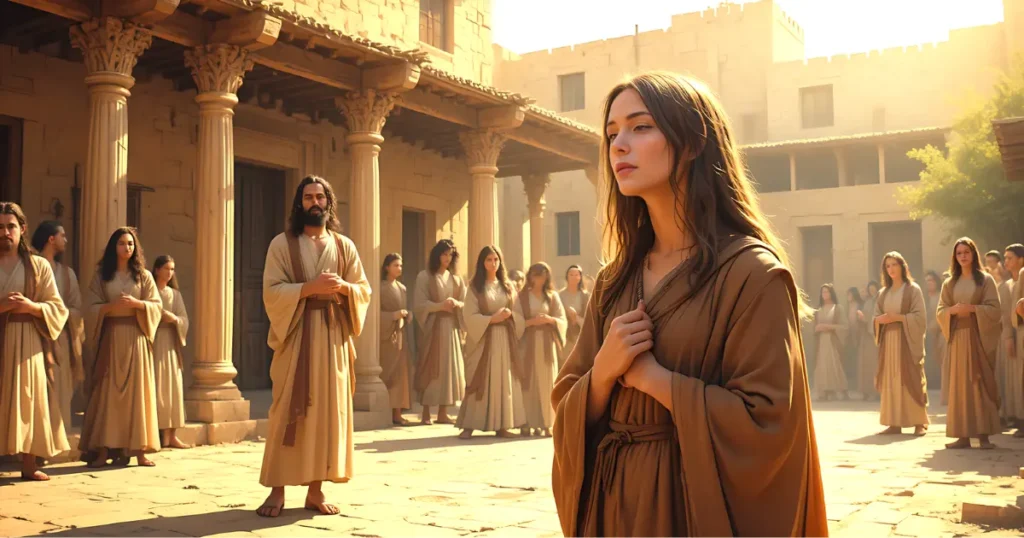
Hannah, Elkanah, and Peninnah
Elkanah was Hannah’s husband, and the Bible says he had two wives, Hannah and Peninnah. Peninnah had children, but Hannah had none. This difference became a deep source of pain, especially because Peninnah repeatedly provoked Hannah about her childlessness.
Elkanah clearly cared for Hannah. Each year at Shiloh, he gave her a special portion because he loved her. He even tried to comfort her by asking why she was crying and whether his love meant more to her than ten sons. Yet his love could not take away the grief Hannah carried. Her character study begins with this tension: she was loved by her husband but still deeply wounded by what she could not change.
Why Childlessness Was So Painful in Her World
Childlessness carried serious social weight in ancient Israel. Children were closely connected with family continuity, inheritance, and the future of a household. Hannah’s barrenness therefore brought more than private sadness. It placed her in a painful situation where comparison, family pressure, and social shame could deepen her suffering.
Still, Scripture never says Hannah’s childlessness was proof of personal sin. The text simply presents it as part of her hardship and says that the Lord had not enabled her to conceive. Her response becomes an important picture of faith during hardship. Rather than allowing her pain to pull her away from God, she eventually brought that pain directly to Him in prayer.
The Bible also connects this family pattern with other stories in Genesis involving childlessness, rivalry, and complicated family relationships. This creates a natural connection to Women in Genesis, including Eve and Leah, while keeping Hannah’s own story at the center.
Hannah’s Prayer at Shiloh Changed the Direction of Her Story
Hannah Brings Her Deepest Pain to God
At Shiloh, Hannah went to the house of the Lord carrying deep grief. She wept and prayed honestly instead of hiding what she felt. First Samuel 1:15 records her words: “I was pouring out my soul to the LORD.” That phrase shows the depth of Hannah’s prayer.
She brought her whole burden before God, not just a request for a child. Her persistent prayer came from a relationship with the Lord and a desire to place her pain in His hands. Like Sarah, who also experienced a long season of childlessness, Hannah’s story shows how faith can remain alive during a painful wait.
The Vow She Made Before the Lord
In 1 Samuel 1:11, Hannah made her vow. She asked God for a son and promised to give him to the Lord for all his life. She also promised that no razor would touch his head. This connected her request with lifelong dedication to God’s service.
Hannah was not trying to negotiate with God or manipulate Him. She was surrendering the child she hoped to receive. Among the women in the Bible, her prayer shows that genuine faith can bring a specific request while still giving God the final say.
Eli Misunderstands Her, Then Blesses Her
Eli, the priest at Shiloh, first misunderstood Hannah’s silent prayer and thought she was drunk. Hannah said, with great respect, that she was truly sorry and that she had been praying to the Lord. Eli then blessed her and told her to go in peace. Afterward, Hannah ate, and her face was no longer downcast (1 Samuel 1:12-18).
Her circumstances had not changed yet, but Hannah had changed before God answered her prayer. This point offers a practical lesson in the Christian faith. Prayer does not always bring an immediate answer, but trusting God can change how we carry a burden. Hannah’s example remains meaningful among Women in the Old Testament, and her story also prepares us to understand the faith and faithfulness seen in Ruth.
Samuel’s Birth and the Promise Hannah Kept
God Answers Her Prayer
God answered Hannah’s prayer in His own time. First Samuel 1:19 says that “the LORD remembered her,” and Hannah conceived and gave birth to a son. She named him Samuel.
The exact meaning of the name is discussed in different ways, but Hannah connects it with the fact that she had asked the Lord for him (1 Samuel 1:20). Her answered prayer was not a reward for praying hard enough. The passage presents Samuel’s birth as God’s gracious response to her request.
She Dedicated Samuel to the Lord
Hannah did not forget her vow after Samuel was born. She cared for him until he was weaned, then took him to Shiloh with an offering to present him before the Lord (1 Samuel 1:24-28). She reminded Eli that she was the woman who had prayed there and said,
“I prayed for this child, and the LORD has granted me what I asked of him” (1 Samuel 1:27, NIV).
This moment reveals the depth of Hannah’s faith and Samuel’s significance. She had waited for this child, yet she was willing to give him to the Lord. As Samuel’s mother, Hannah could have held tightly to the son she had prayed for. But instead, she dedicated Samuel to the Lord and kept her vow.
This was not a small sacrifice. Samuel was her long-awaited son, but Hannah knew that her answer to prayer belonged to God, too. The account offers a valuable Bible study lesson about surrender. Faith is not only asking God for what we need. It is also being willing to place His gifts back into His hands.
This dedication becomes central to the story and Samuel’s calling. Her story also connects naturally with Deborah and Esther, two other women whose faith became part of God’s work among His people.

What Hannah’s Prayer Reveals About Her Faith
Her First Prayer Was Honest and Dependent
Hannah’s prayer at Shiloh shows a woman who did not pretend everything was fine. She was deeply troubled, yet she brought her grief, longing, and tears directly to God. She didn’t trust herself; she trusted the Lord, and she gave Him what she couldn’t manage. Hannah expressed her faith through persistent prayer, not by promising God she would do anything if He gave her exactly what she requested.
This is a crucial lesson for Christian faith. Biblical prayer permits us to speak honestly with God while leaving the outcome in His hands. Hannah’s example shows that trusting God does not require hiding pain. That means bringing that suffering to Him.
Her Second Prayer Became a Song of Praise
After Samuel’s birth and dedication, Hannah prayed again. This time, her words were filled with praise. Hannah’s song, recorded in 1 Samuel 2:1-10, begins with her joy in the Lord and moves quickly toward God’s character and power.
She praises God as holy, strong, and completely unlike any other. She says God humbles the proud and lifts the meek and humble. The contrast matters because Hannah’s experience had moved from humiliation to joy, but her praise was larger than her story. She saw a God who notices the people others would overlook, a God who can turn human expectations on their head.
“There is no one holy like the LORD; there is no one besides you; there is no Rock like our God” (NIV).
Her focus had shifted from what she wanted God to do to who God is. Hannah’s prayer also points toward God’s future rule. In verse 10, she speaks of the Lord giving strength to His king and exalting His anointed. This theme is significant in Samuel.
As a woman of faith, Hannah shows that worship can grow from answered prayer into a deeper understanding of God’s character. Her example also speaks to Christian living today. Praise is not only about celebrating what God gives us. It is also about knowing who He is.
BibleProject explains that Hannah’s poem introduces the theme of power reversals that continues throughout Samuel. BibleProject, Hannah’s Poem and Power Reversals.
This theme helps readers see that Hannah’s story is not isolated. Her prayer helps prepare us for the larger biblical story that follows.
Hannah’s experience also connects naturally with Keturah and Zilpah, whose stories provide additional perspectives on motherhood, family, and God’s work through women in Scripture.
Why Hannah Matters in the Larger Biblical Story
Why is Hannah important in the Bible? Her importance goes far beyond becoming Samuel’s mother. Hannah’s story stands at an important point in Israel’s history, as the period of the judges was ending and the nation moved toward the time of its kings. Her private prayer became part of a much larger story about God’s work among His people.
Samuel would become a prophet and leader who helped guide Israel during this transition. Yet the Bible first introduces him through Hannah’s grief, prayer, vow, and faithful surrender. Her story reminds us that God can work through people who seem weak, overlooked, or powerless.
Hannah’s song in 1 Samuel 2 is also important because its themes reach beyond her personal experience. She praises a God who brings down the proud, strengthens the weak, and raises those who have been brought low. These themes continue throughout Samuel as God chooses and removes leaders according to His purposes.
BibleProject explains that the books of Samuel trace Israel’s movement from the period of the judges toward the monarchy, making Hannah’s story an important opening part of that larger narrative. BibleProject, Books of Samuel overview
This makes Hannah an important part of the story of women in the Bible. Her life shows how one woman’s faith, prayer, and obedience can become part of God’s work in ways she could not have seen at the beginning.
Her story also provides a useful point of connection with Tamar, daughter of David and Abital, wife of King David, two women whose stories belong to later stages of Israel’s history.
Lessons From Hannah’s Faith, Prayer, and Trust in God
The Bible account of Hannah offers practical lessons that still speak to believers today. Her example is not about getting what we ask for. It is about learning to trust God through uncertainty.
Bring Your Real Pain to God
Hannah shows that faith does not require pretending to be fine. Bring your grief, fears, and deepest needs to God honestly.
Keep Praying While You Wait
Waiting can be difficult, but Hannah’s example encourages persistent prayer. Prayer is not a formula for getting what we want. It’s a way to stay close to God as we wait.
Trust God Without Trying to Control the Outcome
Hannah made a clear request, but she also surrendered what she hoped to receive. Faith means trusting God’s wisdom even when the outcome is uncertain.
Keep Your Promises to God
When God answered her prayer, Hannah kept her word. Her obedience reminds us that faith includes following through, not simply making promises during difficult moments.
Let Gratitude Become Worship
Hannah’s response moved beyond relief. She praised God for who He is. Gratitude can do the same for us, turning an answered prayer into an opportunity for worship.
These lessons also connect with women such as Bernice and Chloe, showing that faithful women appear throughout Scripture, including the other Women in the New Testament.
Frequently Asked Questions About Hannah
How old was Hannah when she had Samuel?
The Bible does not tell us how old Hannah was when she had Samuel. Scripture focuses instead on her grief, prayer, faith, Samuel’s birth, and her decision to dedicate him to the Lord. Any specific age would be speculation, so it is best to leave the question unanswered where Scripture does.
How many children did Hannah have?
How many children did Hannah have? 3. First Samuel 1 centers on Samuel, but 1 Samuel 2:21 later says that Hannah had three more sons and two daughters. These children are mentioned after Samuel’s dedication, showing that her family grew after the events described in the first chapter.
What happened to Hannah after Samuel?
What happened to Hannah after Samuel? Hannah continued to see Samuel when her family went to Shiloh. Each year, she brought him a little robe, showing her continued care for him (1 Samuel 2:19). The same passage says the Lord blessed Hannah with more children. Scripture does not give a detailed account of the rest of her life.
Final Thoughts on Her Story, Prayer, and Faith
Hannah in the Bible gives us a clear picture of a woman who carried deep pain to God instead of hiding it. She prayed honestly, trusted Him before she saw the answer, and kept her vow after Samuel was born. Her response to God’s faithfulness became worship, not simply relief.
Hannah’s faith reminds us that trusting God does not mean we will always understand His timing or know what He will do. It means we can bring our unanswered prayers, fears, and hopes to Him and leave them in His hands.
If you are keen to explore more stories of faithful women, read more posts about the Women of the Bible.










2 thoughts on “Who Was Hannah in the Bible? Her Story, Prayer, and Faith”