

Who Is Esther in the Bible?
Ever felt like you were placed somewhere for a reason, even if you could not see the full picture yet? If you have ever wondered who Esther is in the Bible, you are really asking about courage, timing, and quiet faith under pressure.
Who is Esther in the Bible? Esther was a Jewish woman who became queen of Persia during the reign of King Ahasuerus, often identified with Xerxes I. The Book of Esther tells her story. She put her life on the line to protect the Jewish people from being wiped out, keeping the covenant line alive while they were in exile.
So, who was Esther in the Bible beyond that quick summary? She lived in the vast Persian Empire, far from Jerusalem, during the period around 486 to 465 BC. This period was the time of exile. People from other countries ruled over God’s people, who were weak and spread out. The book that bears her name is Esther in the Old Testament, yet God’s name is never mentioned in it. That alone grabs attention.
Still, His fingerprints are everywhere. Esther’s rise from orphan to queen was not luck. It was fate. Because she was brave, the Jewish people were saved, and the promises of the covenant went on. Without her, the story of redemption could have looked very different.
That is why her account still matters.
Quick Facts About Esther
Here are essential Esther quick facts to help you understand the historical and biblical framework of the biblical Esther account:
- Time period: Persian Empire, fifth century BC, during the reign of King Ahasuerus, often identified with Xerxes I, around 486 to 465 BC
- Key Scripture: Esther 1 to 10
- Family: Jewish orphan raised by her cousin and guardian, Mordecai
- Enemy: Haman the Agagite, a high official in the Persian court
- King: Ahasuerus, ruler of the vast Persian Empire stretching from India to Cush
- Location: Susa, the Persian capital (also called Shushan)
- Defining moment: Esther 4:14, “For such a time as this”
- Festival established: Purim, commemorating the deliverance of the Jewish people.
These quick facts anchor the narrative historically, politically, and theologically, helping you read the Book of Esther with clarity and context.
You may want to read this post: Who Was Mary Magdalene in the Bible? First Witness of the Resurrection
Historical and Cultural Context of Esther in the Old Testament
To understand who Esther is in the Bible, you have to step into the world she lived in. The account of Esther in the Old Testament unfolds during the height of the Persian Empire in the fifth century BC. This period was after the Babylonian exile. Instead of returning to Jerusalem, many Jewish families settled across Persia.
The empire stretched from India to Cush, covering modern Iran, Iraq, Egypt, and beyond. Jews lived as a minority under foreign rule. They could exercise their religion, but they couldn’t control the government. That tension sits quietly behind the story of Esther in the Bible.
The capital city was Susa, a royal center of power and luxury. Archaeological findings confirm the existence of its massive palace complex. This scenario shows how difficult it would be for a Jewish orphan to gain power in such a system.
You may want to read this post: Who Was Hannah in the Bible? Her Story, Prayer, and Faith
Persian Political Environment
A centralized monarchy ruled the Persian Empire. King Ahasuerus, often identified with Xerxes I, ruled through regional governors called satraps. In Esther 1:19 and 8:8, we learn that the king’s statement had legal force that was hard to undo.
Royal court customs were strict and dangerous. Access to the king was controlled. Esther 4:11 explains that anyone who approached the king without invitation risked death unless he extended the golden scepter. That detail makes her choice in Esther 5:1-2 even more surprising.
Banquet culture also shaped political life. Feasts were not casual dinners. They displayed wealth, power, and alliances. The first few chapters talk about fancy meals that last for 180 days. Later, the banquet of Esther becomes the turning point where Haman’s plot against the Jews in Persia is exposed.
You may want to read this post: The Story of Ruth in the Bible Explained: Summary, Key Verses, and Meaning
Jewish Exile in Persia
The account of Esther takes place after the Babylonian captivity, when the Jewish people had already spent decades in exile. Babylon fell to Persia in 539 BC. Some Jews returned to Jerusalem when Ezra and Nehemiah were in charge in Persia. But many families preferred to stay spread out across the empire.
This period is the backdrop of the Jewish exile in Persia. By the fifth century BC, Jewish neighborhoods had firmly established themselves throughout the Persian Empire, just like in Esther’s time. They were not enslaved. They worked, owned land, and held government jobs. Still, they were a minority of people living under foreign authority. Imperial policy determined their safety.
The city of Susa plays a central role. Susa in the Bible appears as a royal capital where Persian kings conducted state business. Excavations show that it was a political and administrative center. Esther and Mordecai lived there among other Jews who had built lives far from Jerusalem.
You may want to read this post: Who Is Eve in the Bible? Creation, Fall, and Key Verses
This context explains the narrative’s tension. The promises made to Abraham in the covenant still stood. But the people were spread out. There was no Davidic king on the throne in Jerusalem. No evident strength in the country. The threat from Haman was not just personal revenge. It was a potential attempt to wipe out a covenant people living in diaspora.
Many competitors briefly mention exile, but the structure matters. First came the Babylonian deportation. Then the Persians were tolerant. Then spread out over the provinces. Esther’s account sits within this second stage of exile life, where survival required wisdom, restraint, and sometimes courage inside foreign systems of power.
You may want to read this post: Who Was Deborah in the Bible? Judge and Prophetess of Israel
The Story of Esther in the Bible
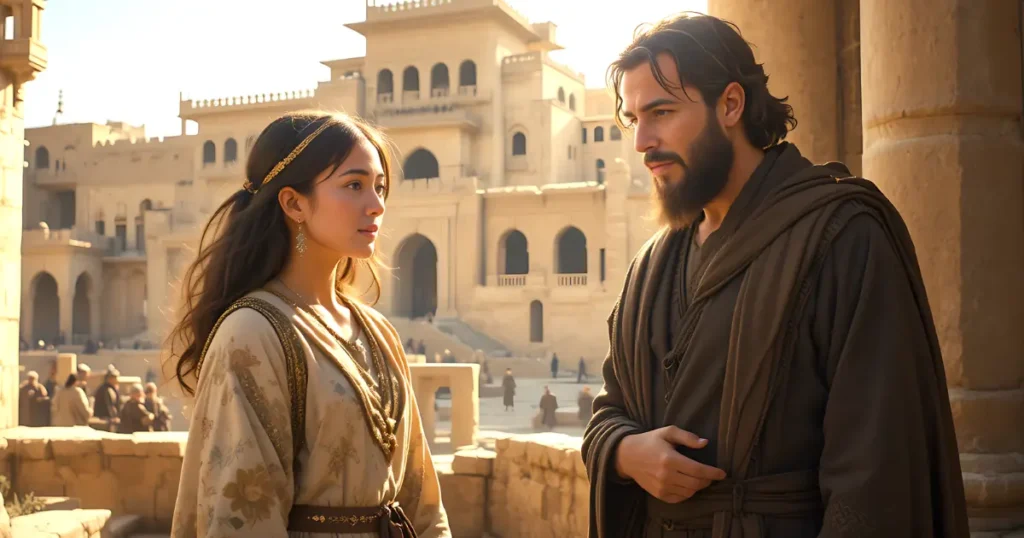
The story of Esther in the Bible is full of suspense, quiet moments, and unexpected twists. It isn’t a story from a fairy tale. It is about staying alive in a pagan empire. It reveals how God protected His people while they were in exile, even though His name was not spoken.
Rise to Queen
Esther 2:7 introduces us to Hadassah, also called Esther. The text states that she was a young Jewish woman with “a beautiful figure and was lovely to look at.” It further says that her cousin Mordecai took her in after her parents died and raised her as his daughter.
What the text explicitly says:
- She was an orphan.
- Mordecai raised her.
- She was taken into the king’s harem after Queen Vashti was removed.
What we reasonably understand from history:
Persian kings gathered women from across the empire. The act wasn’t romantic. It showed political and cultural power.
According to Esther 2:10, Esther concealed her Jewish identity because of Mordecai’s instruction. The passage does not explain why he did so. In the past, Jews were not very common in the Persian court. Hiding may have been a smart way to protect yourself, not a sign of shame.
This dynamic between Esther and Mordecai continues throughout the narrative.
The Plot Against the Jews
The conflict intensifies with Haman. Esther 3 explains that King Ahasuerus promoted Haman above other officials. Everyone was told to bow down to him.
Mordecai refused.
The text states clearly that he would not bow or pay homage. It doesn’t go into enough detail about why. Some academics propose religious conviction. Others point to ethnic tension, since Haman is identified as an Agagite.
Haman’s response was extreme. Instead of punishing Mordecai alone, he issued a decree for the destruction of all Jews throughout the empire. This was the conspiracy against the Jews in Persia.
The decree was sealed with the king’s signet ring. Persian law made it hard to change such orders.
This scenario sets up the central tension between Esther and Haman.
“For Such a Time as This”
Esther hesitated to approach the king. Esther 4:11 explains that anyone who entered the king’s presence uninvited could be killed.
Mordecai’s response appears in Esther 4:14.
What the text explicitly states:
He told her that if she remained silent, relief and deliverance would arise from another place, but she and her father’s house would perish. Then he questioned her whether she had become queen “for such a time as this.”
What is interpretation?
The verse suggests divine providence, yet God is not named. The book allows readers to see His hidden hand without explicitly stating it.
Esther chose to act. She didn’t eat. After that, she went to see the king.
The Banquets and Reversal
The turning point comes through strategy, not impulse. The banquet in Esther, chapters 5-7, becomes the stage for reversal.
She invited the king and Haman to two private banquets. During the second, she revealed her Jewish identity and exposed Haman’s plan.
Esther 7 records the king’s anger. Haman was hanged on the gallows he had made for Mordecai.
Yet one problem remained. Persian law could not simply cancel the first decree. A new law was passed that allowed Jews to protect themselves instead. The end outcome was freedom.
This event became the origin of Purim, the annual Jewish festival commemorating their survival.
Through courage, wisdom, and timing, the crisis turned into protection for God’s covenant people.
Key Bible Passages Explained about Esther
To understand the depth of Esther’s account, we need to slow down and carefully examine the key verses. These important Bible verses about Esther reveal both the plain meaning of the text and the theological weight behind it.
Esther 2:7 Meaning
Esther 2:7 states that Mordecai “had brought up Hadassah, that is, Esther, the daughter of his uncle, for she had neither father nor mother.”
What the text says clearly:
- She was an orphan.
- Mordecai raised her.
What we understand by reasonable interpretation:
Mordecai functioned as a legal guardian and likely as a father figure. First, the verse portrays weakness and then strength. Esther’s ascent to the throne commences with adversity rather than advantage. That contrast shapes the entire narrative arc.
Esther 4:14 Explanation
Esther 4:14 is one of the most quoted lines in the book.
The text states that if Esther remains silent, “relief and deliverance will arise for the Jews from another place.” It also states that she and her father’s house will perish.
The text does not mention God directly.
Interpretation:
Mordecai expresses covenant confidence. He believes God will keep his promises to Abraham and that the Jews will not be destroyed. This statement is a strong theological anchor that doesn’t name God directly.
Esther 5:2 Meaning
Esther 5:2 records that when the king saw Esther standing in the court, she won favor, and he held out the golden scepter.
The text clearly states the protocol in 4:11. Uninvited admission could lead to death.
The meaning here is concrete. Esther risked her life. There was no guarantee of royal favor. The long scepter means that someone is accepted and protected by the law in a Persian court.
Esther 7:3 to 6 Explained
In Esther 7:3-6, Esther publicly identifies herself as a Jew and exposes Haman’s plan.
The text states she says, “We have been sold, I and my people, to be destroyed.”
This is the first time anyone has publicly said who she is. The risk becomes both personal and national. Her remarks change the story from secret survival to open conflict.
These passages anchor the book’s theological and historical weight.
Theological Meaning of Esther in the Bible
The meaning of Esther in the Bible goes far beyond palace drama. The book’s main message is to have peaceful faith in God’s rule when things are uncertain. The spiritual meaning of Esther centers on hidden faithfulness, courageous obedience, and the unseen guidance of God in exile.
Why Is God Not Mentioned?
One of the most striking features of Esther is this simple fact: God’s name is never mentioned.
That is a text observation, not speculation. There are no written prayers. No speeches from prophets. No miracles are mentioned.
Yet the narrative unfolds with precision. The king couldn’t sleep in Esther 6 when the banquets took place. The appropriate time to expose Haman. These events form a chain of reversals that strongly imply providence in Esther.
Theologically, the silence invites readers to see God’s hand without explicit commentary. God’s might is exhibited via everyday things. God’s name may not be mentioned, but God is still active.
God’s Purpose for Esther
The immediate purpose in the text is clear. A proclamation threatened to wipe out all Jews in the Persian Empire.
If carried out, it would have meant national annihilation.
Esther’s courage prevented that outcome. The struggle wasn’t just about staying in power. It was covenant preservation. The promises given to Abraham required a living people.
God’s purpose for Esther, as presented in the narrative, was to place her in a position where her actions would preserve that covenant community.
Esther and Redemptive History
When we place Esther in redemptive history, the stakes become even clearer.
The Messiah would later come through the Jewish nation. If the order had worked, the covenant line would have been in danger. Esther’s intervention protected the people through whom Christ would eventually be born.
The book does not state the issue directly. But within the broader canon of Scripture, the connection is unmistakable.
Esther’s account shows that, even in exile and in silence, God guards His redemptive plan.
Her Role in the Biblical Narrative
When we ask who Esther is in the Bible, we are really asking how one woman’s obedience helped avert a national crisis.
Her immediate action led to the survival of the Jews. The decree calling for destruction was real. It had the king’s power. But since she stepped in, a counter-decree allowed the Jewish people to protect themselves, meaning they could take measures to defend their community against the threat. What began as a certain threat ended in deliverance.
The narrative moves from fear to reversal. Haman builds gallows for Mordecai. Instead, they kill Haman. A day set for slaughter turns into a day of victory. There is a reason for the literary inversion. It shows how concealed sovereignty works through the choices people make.
Esther’s defining response appears in 4:16:
"Go, gather all the Jews to be found in Susa, and hold a fast on my behalf… Then I will go to the king, though it is against the law, and if I perish, I perish."
The text presents resolution, not drama. She knows there is a risk. She keeps going regardless.
The long term impact was the establishment of Purim, an annual reminder that survival came through unexpected means. The event was a turning point from weakness to strength.
I once heard a pastor describe Esther as someone who obeyed before she understood the outcome. That idea stuck with me. In the Bible, courage often begins with simple obedience rather than perfect understanding.
Her role shows that faithfulness inside ordinary systems of power can shape redemptive history without loud miracles.
Timeline of Esther’s Life
Below is a clear timeline of Esther’s life, presented in chronological order. This structure also functions as a simple Esther chapter summary, helping you trace the narrative movement from crisis to deliverance.
• Deposition of Queen Vashti
Esther 1 records that Queen Vashti refused King Ahasuerus’s command during a royal banquet. As a result, she was let go from her job. This political choice opened the way that would eventually lead Esther into the palace.
• Esther Chosen as Queen
In Esther 2, after a kingdom wide search, Esther was selected and crowned queen in Susa. Under Mordecai’s watchful eye, her Jewish identity stayed hidden.
• Haman’s Promotion
Esther 3 explains that Haman was elevated to a high position of authority. All of the officials had to bow down to him.
• Decree Issued Against the Jews
When Mordecai refused to bow, Haman responded with a sweeping decree calling for the destruction of the Jewish people across the empire. The order was sealed and sent all over Persia.
• Fast and First Banquet
In Esther 4, Esther called for a three day fast before approaching the king. She held the first private dinner with the king and Haman in Esther 5.
• Second Banquet and Reversal
At the second banquet in Esther 7, Esther revealed Haman’s plot. Haman was hanged on the gallows he had built for Mordecai.
• Purim Established
Esther 9 records the Jewish victory and the establishment of Purim as an annual, lasting celebration of deliverance.
This timeline shows how quickly events escalated and how decisively they were reversed within the Persian court narrative.
Esther as a Woman of Courage and Leadership
When we look closely at Esther’s characteristics in the Bible, we see more than bravery. We see strong leadership even when things are tough. We perceive understanding. We can see when. We perceive wisdom in a system that is set up to fail her.
Esther did not begin with public authority. She was an orphan. She was a member of a small group that had to leave their country. But she became more powerful without losing control.
Here are key character traits of Esther:
- Courage rooted in responsibility, not ego
- Patience under extreme tension
- Strategic communication in a hostile court
- Loyalty to her people
- Willingness to risk personal safety
Her leadership under pressure stands out. She didn’t fear when the order said it would kill everyone. She didn’t eat. She got people to back her up. She made sure to plan well before going to the king. That shows discernment and self control.
Her communication was strategic. She did not accuse Haman immediately. She made room for Esther’s meal. She let the tension build up. Then she spoke clearly and publicly identified with her people.
Among Old Testament women leaders, Esther’s leadership differs from Deborah’s. Deborah was a judge and prophet in Israel who led openly. Esther led calmly in a foreign empire. One exercised public authority. The other works within political systems. Both took bravery.
Esther also shares something with Ruth. Ruth showed loyal commitment in hardship. Esther was committed to the covenant even when she was in danger. They both helped Israel’s future in distinct ways.
The lessons from Esther for women today are grounded in action rather than sentiment. Leadership is not always loud. It can be patient at times. It waits sometimes. It talks at just the perfect time sometimes.
That is strength shaped by wisdom.
Frequently Asked Questions
1. Is Esther a true historical figure?
The Book of Esther is set in the Persian Empire during the reign of King Ahasuerus, commonly identified with Xerxes I (486 to 465 BC). The story talks about real places like Susa and well-known Persian customs. For a long time, Jewish tradition has regarded Esther as a real person whose actions kept the Jewish community alive during exile.
2. Why did Esther hide her Jewish identity?
Esther 2:10 states that Mordecai instructed Esther not to reveal her nationality or family background, so she kept it secret. The passage does not exactly say why. Many academics say that Jews were a small group in the Persian court; hiding their identity may have been a smart move for safety and power.
3. How old was Esther when she became queen?
The biblical text never gives Esther’s exact age. The Book of Esther simply describes her as a young woman chosen during the royal selection process after Queen Vashti’s removal. Because the Bible doesn’t specify how many years, any specific age often brought up in current conversations is just a guess, not a biblical reality.
4. What happened to Esther after the book ended?
The Book of Esther closes with the establishment of Purim and the continued influence of Mordecai in the Persian court (Esther 10). The Bible says nothing else about Esther’s life after that. Some Jewish sources say she stayed in Persia, although the Bible provides no further historical information.
5. What does Esther teach about leadership during a crisis?
The narrative shows leadership shaped by timing, courage, and careful judgment. Esther did not rush her decision. She didn’t eat, got help, and smartly went to the king. When people wonder who Esther is in the Bible, they are referring to a leader who made quick decisions when her people were in danger of being destroyed.