

Introduction of Rebekah in the Bible
In the Bible, Rebekah was Isaac’s wife and the mother of Jacob and Esau. Her story appears in Genesis 24-27. After Abraham’s servant chose her to be Isaac’s wife, she became part of God’s covenant family. Rebekah later played an important role in the events that shaped Israel’s future.
Have you ever wondered, “Who was Rebekah in the Bible,” and why her story still sparks conversation thousands of years later? At first glance, the Rebekah Bible story seems simple: a young woman meets Abraham’s servant at a well and becomes Isaac’s wife. But look closer, and things get a little more interesting.
In the Book of Genesis, Rebekah emerges as one of the most influential matriarchs of the Old Testament. She becomes Rebekah, mother of Jacob and Esau, two brothers whose rivalry shaped the future of Israel. Her story includes hospitality, prayer, family tension, and a bold decision that changed the covenant family forever.
Today, many readers see her as a complex woman of faith. In fact, a 2023 survey by the American Bible Society found that 74 percent of practicing Christians read the Old Testament for life lessons and spiritual guidance. Rebekah’s life in Genesis continues to offer exactly that.
Who Was Rebekah in the Bible
So who is Rebekah in the Bible, and why does her story stand out in the book of Genesis? Rebekah is one of the key matriarchs of Israel and an important biblical character in the Old Testament narrative. Her life unfolds in Genesis 24 through Genesis 27, where she becomes part of God’s covenant family and helps shape the future of the nation of Israel.
Rebekah was born into Abraham’s extended family in Mesopotamia. She was the daughter of Bethuel and the sister of Laban. When Abraham’s servant came to her home country to find a wife for Isaac, her life changed significantly. In a remarkable moment at a well, Rebekah offered water and generous hospitality, a decision that led to her becoming Isaac’s wife and joining Abraham’s household.
You may want to read this post: Who Was Rachel in the Bible? Story, Marriage, and Meaning
Once she married Isaac, Rebekah became central to the unfolding story of God’s promise to Abraham. She later gave birth to twin sons, Jacob and Esau, making her the mother of two brothers whose lives would influence the history of Israel.
One of the most fascinating facts about Rebekah in the Bible is that God spoke directly about her unborn children, declaring that two nations would come from them. This prophecy put her at the heart of a dramatic story about faith, family conflict, and the continuation of God’s covenant promise.
You may want to read this post: Who Is Eve in the Bible? Creation, Fall, and Key Verses
Rebekah in the Bible at a Glance
The life of Rebekah in the Bible unfolds primarily in Genesis and connects several major figures in Israel’s early history. Her tale shows how faith, hospitality, and family can all play a role in God’s plan.
In Rebekah in Genesis, we learn several important details:
- Husband: Isaac
- Father: Bethuel
- Brother: Laban
- Children: Jacob and Esau
- First appearance: Genesis 24
- Main story sections: Genesis 24 through Genesis 27
These details help frame the larger Rebekah story in Genesis, where her decisions affect the covenant family and Israel’s future lineage.
You may want to check out this post: Who Is Sarah in the Bible? Her Story, Faith, and God’s Promise
Where Rebekah Appears in the Bible
If you’re curious about Rebekah’s presence in the Bible, you’ll find her entire story in the book of Genesis. Three key chapters in the Bible contain the main verses about Rebekah, forming an important part of the patriarchal narrative.
First, Rebekah in Genesis 24 introduces her dramatic meeting with Abraham’s servant at a well. This chapter tells the story of how Sarah was chosen as Isaac’s wife because she was so kind and welcoming. The passage highlights God’s guidance in bringing Rebekah into Abraham’s covenant family.
Next, Genesis 25 describes an important season in her life. Before Isaac prayed for her, Rebekah had a hard time getting pregnant for a long time. God heard her petition and gave her twin sons, Jacob and Esau. During her pregnancy, God revealed a prophecy that two nations would come from her children.
Finally, Genesis 27 records the famous moment when Rebekah helped Jacob receive Isaac’s blessing, a turning point in Israel’s history.
You may want to read this post: Who Was Hagar in the Bible? Her Story, Faith, and the Birth of Ishmael
The Story of Rebekah in the Bible
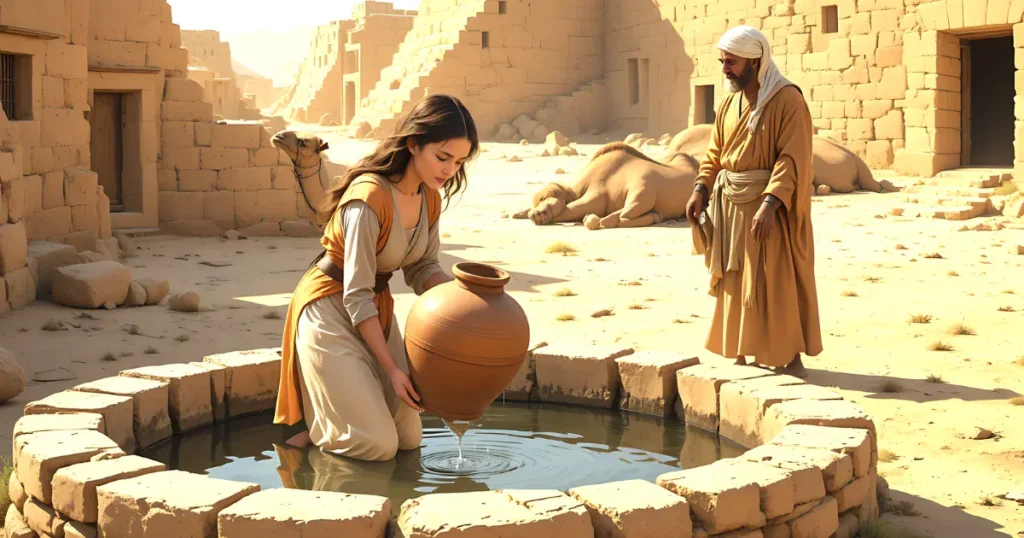
The story of Rebekah in the Bible unfolds across several chapters in Genesis and reveals one of the most fascinating narratives among the matriarchs of Israel. The Bible account of Rebekah includes passages where people are kind to one another, pray, fight with their families, and make predictions about the future. Through the story of Rebekah in Genesis, readers see how one woman became part of God’s covenant plan and helped shape the future of the nation of Israel.
Her life begins with a remarkable meeting at a well, continues through years of waiting for children, and later becomes intertwined with one of the most dramatic family conflicts in Genesis. Each part of Rebekah’s story highlights God’s guidance in the lives of ordinary people and shows how human choices can influence the unfolding of biblical history.
You may want to check out this post: Who Was Hannah in the Bible? Her Story, Prayer, and Faith
Rebekah Chosen as Isaac’s Wife (Genesis 24)
The first chapter of the Bible story of Rebekah begins when Abraham sends his trusted servant on an important mission. Abraham wanted Isaac to marry someone, but he didn’t want Isaac to marry a Canaanite. Instead, he instructed his servant to travel back to his relatives and find a suitable woman for Isaac.
Before arriving, the servant prayed for guidance. He prayed to God for a sign: the ideal woman would not only provide him with water but also draw water for his camels. Soon after, he met Abraham’s servant and Rebekah at a well outside the city.
You may want to check out this post: Who Was Phoebe in the Bible? Her Role in Romans 16 Explained
Rebekah approached with a jar on her shoulder. When the servant asked for a drink, she gladly gave him water. Then she said she would get water for all of his camels, too. This act of kindness and hard work was quite impressive. In the ancient world, watering camels required significant effort, making Rebekah’s hospitality at the well an impressive display of character.
The servant immediately recognized that God had answered his prayer. After learning she was part of Abraham’s extended family, he explained his mission to her household. Rebekah agreed to travel to Canaan and become Isaac’s wife, demonstrating courage and faith.
You may want to read this post: The Story of Ruth in the Bible Explained: Summary, Key Verses, and Meaning
Rebekah’s Marriage to Isaac
After agreeing to the journey, Rebekah left her homeland and traveled with Abraham’s servant toward Canaan. The long voyage was a big turning point in her life and in the saga of the covenant family.
When the caravan arrived, Isaac was walking in the field when he first saw her approaching. Isaac and Rebekah’s moment is one of the most touching episodes in the Bible. Rebekah covered herself with a veil, a traditional sign of modesty, before meeting her future husband.
Soon after, Isaac marries Rebekah, and she becomes his wife, joining the family line through which God’s promises to Abraham would continue.
You may want to check out this post: Who Is Esther in the Bible? Story, Key Verses, and Meaning
Rebekah’s Barrenness and Isaac’s Prayer (Genesis 25)
Like Sarah before her, Rebekah, barren in the Bible, experienced a painful season of infertility. For many years after their marriage, she was unable to have children. This challenge was especially difficult because the covenant promise depended on future generations.
The Bible records that Isaac prayed to the Lord for his wife. God answered his prayer, opening Rebekah’s womb and allowing her to conceive.
Was Rebekah infertile in the Bible?
Rebekah was unable to have children for many years after marrying Isaac. According to Genesis 25:21, Isaac prayed to the Lord on behalf of his wife, and God responded to his prayer. Rebekah later gave birth to twin sons, Jacob and Esau.
You may want to read this post: Who Was Deborah in the Bible? Judge and Prophetess of Israel
The Birth of Jacob and Esau
Rebekah’s pregnancy was far from simple. The Bible says the twins struggled within her womb, causing great distress. Confused by what was happening, she sought the Lord for an explanation.
Eventually, she gave birth to two very different boys. As Rebekah, the mother of Jacob and Esau, she became the parent of twins whose rivalry would shape biblical history. Their lives were already full of violence before they were even born.
God’s Prophecy to Rebekah
During her difficult pregnancy, Rebekah received a powerful message from God about her unborn children. The Lord told her that the fight she was having had a more profound meaning, one that concerned the future of nations.
What did God promise Rebekah?
During her pregnancy, God told Rebekah that two nations were in her womb and that the older son would serve the younger. This prophecy in Genesis 25:23 revealed that Jacob would carry forward the covenant line.
This Rebekah prophecy about Jacob and Esau showed that God’s plan would unfold in unexpected ways.
You may want to check out this post: Who Was Mary Magdalene in the Bible? First Witness of the Resurrection
Rebekah and the Blessing of Jacob (Genesis 27)
Years later, family tensions reached a turning point. Isaac wanted to bestow the traditional blessing on his oldest son, Esau. However, Rebekah remembered the prophecy about her sons and believed Jacob was meant to receive the blessing.
In one of the most dramatic moments in Genesis, Rebekah and Jacob worked together to ensure the blessing went to Jacob instead. Rebekah’s role in Jacob’s blessing involved disguising him so Isaac would believe he was blessing Esau.
The plan succeeded, but it also created deep family conflict. Esau became furious, and Jacob eventually had to leave home.
This event raises an important question many readers ask: why did Rebekah help Jacob? Some believe she was trying to fulfill God’s prophecy, while others see it as a reminder that even people in the Bible sometimes take matters into their own hands.
You may want to check out this post: Who Was Leah in the Bible? Story, Sons, and Her Role in God’s Plan
Key Bible Passages About Rebekah
Several important Bible verses about Rebekah appear in the book of Genesis. These passages show how her life fits into the larger story of God’s covenant family. The narrative of Rebekah in Genesis highlights moments of hospitality, divine prophecy, and family decisions that shaped Israel’s future.
Her story unfolds mainly in three chapters. Genesis 24 introduces her meeting with Abraham’s servant and her journey to become Isaac’s wife. Genesis 25 describes her long struggle with infertility and the prophecy about the twins she carried. Later, Genesis 27 records the dramatic moment when Jacob receives Isaac’s blessing with Rebekah’s help.
Together, these passages reveal Rebekah as a woman deeply connected to God’s unfolding plan in the patriarchal narratives.
You may want to check out this post: Who Was Tabitha (Dorcas) in the Bible? Her Powerful Story in Acts 9
Genesis 24: Rebekah Meets Abraham’s Servant
Genesis 24 presents one of the most memorable scenes of Rebekah in Genesis. At a well outside the city, Rebekah offers water to Abraham’s servant and generously draws water for his camels. Her compassion and hospitality are signs that God has chosen her to be Isaac’s wife.
Genesis 25: God’s Message About the Twins
In Genesis 25, Rebekah experiences a difficult pregnancy. The twins struggle within her, causing concern. When she seeks God, He reveals that two nations are in her womb and that the older will help the younger. This prophecy is a key moment in the Bible’s accounts of Rebekah.
Genesis 27: The Blessing Given to Jacob
Genesis 27 records the dramatic moment when Isaac prepares to bless Esau. Remembering God’s earlier prophecy, Rebekah guides Jacob to receive the blessing instead. This event fulfills the message given during her pregnancy and becomes a turning point in the story of Jacob and Esau.
You may want to check out this post: Who Was Bilhah in the Bible? Her Story, Sons, and Role in Jacob’s Family
Historical and Cultural Background of Rebekah’s Story
To fully understand Rebekah in the Genesis narrative, it is helpful to examine the historical and cultural context of the story. Many details in Genesis make more sense when we understand the customs of ancient Near Eastern life.
First, wells were central gathering places in ancient communities. The wells in the Bible have significance that goes beyond mere water provision. Wells were places where travelers could meet, rest, and take part in important events.
In Genesis 24, the meeting between Abraham’s servant and Rebekah at the well fits this cultural setting perfectly. Women commonly came to draw water for their households, which explains why Rebekah was there when the servant arrived.
You may want to check out this post: Who Was Basemath in the Bible? One of Esau’s Wives in Genesis
Marriage customs also shaped the story. Ancient marriage customs in Genesis often involved family negotiations and the involvement of trusted servants in arranging matches. In patriarchal culture, it was usual for a man to send his servant to find a marriage for his son. Families played a central role in approving marriages, and preserving family lineage was extremely important.
Another key cultural element is the inheritance and blessing in Genesis. In patriarchal families, a father’s blessing carried legal and spiritual significance. It determined leadership within the family and often influenced the future inheritance. This background explains why the blessing Isaac intended to give his son was so important and why the events surrounding Jacob and Esau created such intense conflict.
You may want to check out this post: Who Was Keturah in the Bible? Abraham’s Wife and Mother of Six Sons
Why Rebekah Is Important in the Bible
So why is Rebekah important in the Bible? Her story matters because she stands at a crucial point in God’s covenant plan. As the biblical matriarch Rebekah, she became part of the household that God used to keep His promises to Abraham.
God had promised Abraham that his descendants would become a great nation (Genesis 12:2). That promise continued through Isaac, and Rebekah became the woman who carried the next generation of that covenant family. Through her marriage to Isaac, she entered the Rebekah covenant family, linking Abraham’s promise to the future people of Israel.
Rebekah’s importance becomes even clearer through her children. She was the mother of Jacob and Esau, although Jacob would later become Israel, the father of the twelve tribes. This makes Rebekah central to Israel’s lineage. Her family line directly shaped the history of the nation of Israel.
She also holds a special place among the matriarchs of Scripture. Alongside Sarah, Rachel, and Leah, Rebekah represents the women through whom God’s covenant promises moved forward. Her tale reveals how God often uses ordinary individuals and complex family situations to achieve His greater goals.
In the Genesis narrative, Rebekah is not just a supporting character. She is a key figure in the unfolding story of God’s people.
Lessons from Rebekah’s Life for Christians
The lessons from Rebekah in the Bible are both encouraging and challenging for modern believers. Her story shows a woman with strong faith, real flaws, and a life deeply connected to God’s larger plan. When we read Genesis closely, we can learn a lot about Rebekah’s faith.
First, Rebekah demonstrates the power of kindness and generosity. When she offered water to Abraham’s servant and his camels, she showed remarkable hospitality. This moment highlights one of Rebekah’s most admirable characteristics in the Bible. Her humble act of service was the turning point that led to her marriage to Isaac and her place in the covenant family.
Second, Rebekah reminds believers to trust God’s promises. During her difficult pregnancy, she sought the Lord for understanding. God revealed that her children would become two nations. This moment teaches an important truth about what we can learn from Rebekah: bringing our confusion and struggles to God is always the right response.
At the same time, her story also warns about favoritism. Rebekah favored Jacob over Esau, which contributed to serious family conflict. But God’s plan kept moving forward even when people made mistakes.
Her life reminds Christians that God works through imperfect people to accomplish His purposes.
Timeline of Rebekah’s Life in Genesis
A simple timeline of Rebekah’s life in the Bible helps readers understand how the major events unfold across Genesis.
- Meeting Abraham’s servant (Genesis 24): Rebekah first appears at a well, where her kindness and hospitality lead Abraham’s servant to recognize her as the woman God has chosen for Isaac.
- Marriage to Isaac (Genesis 24): Rebekah travels to Canaan and becomes Isaac’s wife, joining Abraham’s covenant family.
- Years of barrenness (Genesis 25): For many years, Rebekah is unable to have children until Isaac prays and God answers.
- Birth of Jacob and Esau (Genesis 25): Rebekah gives birth to twin sons whose rivalry begins even before they are born.
- Jacob receives Isaac’s blessing (Genesis 27): Rebekah helps Jacob receive the blessing meant for Esau, shaping the future of Israel’s story.
Final Thoughts on Rebekah in the Bible
Rebekah in the Bible stands out as one of the most influential women in the Old Testament. As the wife of Isaac and the mother of Jacob and Esau, she played a vital role in the continuation of God’s covenant promise to Abraham. Her story in Genesis reveals a woman whose actions helped shape the future of Israel and the unfolding narrative of God’s people.
Rebekah’s life shows both strength and complexity. She demonstrated faith and generosity when she welcomed Abraham’s servant at the well. Later, her courage and decisiveness influenced the events that led to Jacob receiving Isaac’s blessing. These moments help us understand why Rebekah is important in the Bible and why her narrative continues to be studied today.
At the same time, the lessons from Rebekah in the Bible remind believers that God often works through imperfect people. Her life encourages Christians to practice hospitality, seek God in difficult moments, and trust His promises even when circumstances feel uncertain.
Studying Rebekah’s story invites us to reflect on how faith, wisdom, and courage can guide our lives as we follow God’s purposes.
Read more posts on Women of the Bible to discover other inspiring stories of faith.
Frequently Asked Questions About Rebekah in the Bible
What Does the Name Rebekah Mean in the Bible?
The meaning of Rebekah in the Bible is commonly understood as “to tie,” “to bind,” or “to captivate.” Many Bible scholars believe the name suggests someone whose beauty or character draws others in. In the Rebekah Bible story, her name fits perfectly because her kindness and hospitality quickly captured the attention of Abraham’s servant when he met her at the well in Genesis 24. Her character, kindness, and bravery made her a good matriarch in God’s covenant family.
How Old Was Rebekah When She Married Isaac?
The Bible does not give an exact age for Rebekah when she married Isaac. However, many scholars estimate that Rebekah was in her teens when she married Isaac, which was typical of marriage in the patriarchal period. Genesis 24 says that she was a young woman living with her family when Abraham’s servant came. Isaac, on the other hand, was nearly forty years old when he got married to Rebekah (Genesis 25:20).
When Did Rebekah Die in the Bible?
The Bible does not directly record the date of Rebekah’s death. Unlike some other biblical figures, Scripture does not mention the circumstances or timing of her death. However, Genesis later records the death of her nurse Deborah in Genesis 35:8, which suggests that Rebekah had already passed away or was no longer present in the narrative by that time. Because of these factors, the exact details of her death remain unknown in the biblical record.