
Who Was Mary the Mother of Jesus in the Bible?
Mary the mother of Jesus, was a young woman from Nazareth, chosen by God to bring Jesus into the world through a miracle known as the Virgin Birth. If you’re asking who Mary was, the Bible shows her as a humble servant who trusted God and became part of His plan of salvation. In the Gospels, Mary, the mother of Jesus, is not just a background figure. She is present from the beginning of Jesus’ life to the cross and even after the resurrection.
Introduction to Mary the Mother of Jesus
Mary, the mother of Jesus, matters far more than many people realize. When we look at the story of Mary, the mother of Jesus, we see more than a birth story. We see a life shaped by faith, risk, and obedience.
The Bible introduces Mary as a simple young woman, yet her calling was anything but simple. She said yes to God when it could have cost her reputation, her future, and even her safety. That is why Mary from the Bible continues to stand as a real example of trust in hard moments.
"I am the Lord's servant," Mary answered. "May your word to me be fulfilled." (Luke 1:38)
Her story is still studied and remembered worldwide. In fact, research shows that devotion to Mary has had a strong impact on believers, with about 74% saying it strengthened their faith and their sense of calling, according to a study by the Center for Applied Research in the Apostolate.
Think about a real-life moment. A young woman finds out she is pregnant at the wrong time. People talk. She feels fear. However, rather than fleeing, she gradually comes to trust God. That is the kind of quiet courage we see in Mary.
As we move forward, we will look closely at her life, her faith, and her role in God’s plan, not just what happened, but what it means for us today.
You may want to read this post: Who Was Mary Magdalene in the Bible? First Witness of the Resurrection
Facts About Mary the Mother of Jesus
If you’re looking for facts about Mary the mother of Jesus, here are simple and clear points that help you understand her life. Many people ask, “What are 5 facts about Mary? ” But her story gives us even more insight.
- Mary was from Nazareth
She lived in a small village in Galilee, known for its simple and quiet life. - She was chosen by God to be the mother of Jesus
God gave her a unique role in bringing the Messiah into the world. - She was a virgin when Jesus was born
The Bible teaches that Jesus’ birth was a miracle through the Holy Spirit (Luke 1:34–35). - She was visited by the angel Gabriel
Gabriel told her about God’s plan, and she responded with faith and trust. - She was present at Jesus’ crucifixion
“Near the cross of Jesus stood his mother…” (John 19:25)
She stayed even in deep pain. - She was with the early believers in Acts 1
After Jesus’ resurrection, Mary is seen praying with the disciples. - She is known for her faith and obedience
Her life reflects trust in God, even when the path was unclear.
These facts show that Mary was not just part of one moment in history. Her whole life points to steady faith and a willingness to follow God’s plan.
You may want to check out this post: Who Is Esther in the Bible? Story, Key Verses, and Meaning
Key Bible Passages About Mary the Mother of Jesus
The story of Mary is best understood by looking closely at Mary, the mother of Jesus, Bible verses found across the Gospels, and early church accounts. These passages show her journey from a young woman in Nazareth to a witness of Jesus’ death and the beginning of the church.
In Mary’s account in Luke 1, the angel Gabriel appears and tells her she will give birth to the Messiah. Mary responds with faith:
"I am the Lord's servant… May your word to me be fulfilled." (Luke 1:38)
This moment sets the foundation of her obedience and trust.
In Mary in Luke 2, we see the birth of Jesus. Mary gives birth in humble conditions and later reflects deeply on what is happening:
"But Mary treasured up all these things and pondered them in her heart." (Luke 2:19)
In Matthew 1, the focus shifts from Mary to Joseph. An angel reassures him that Mary’s pregnancy is from the Holy Spirit, protecting her from shame and showing God’s hand in every detail.
One of the most powerful scenes is Mary at the cross, John 19. As Jesus is crucified, Mary stands near him. Even in suffering, she remains present. Jesus says:
"Woman, here is your son… Here is your mother." (John 19:26–27)
Finally, Mary in Acts 1 is seen with the disciples after the resurrection, praying and waiting to see what comes next. This indicates that she was there at the beginning and in the early church.
Together, these passages reveal a full picture of Mary’s life, marked by faith, endurance, and quiet strength.
You may want to read this post: The Story of Ruth in the Bible Explained: Summary, Key Verses, and Meaning
The Story of Mary the Mother of Jesus
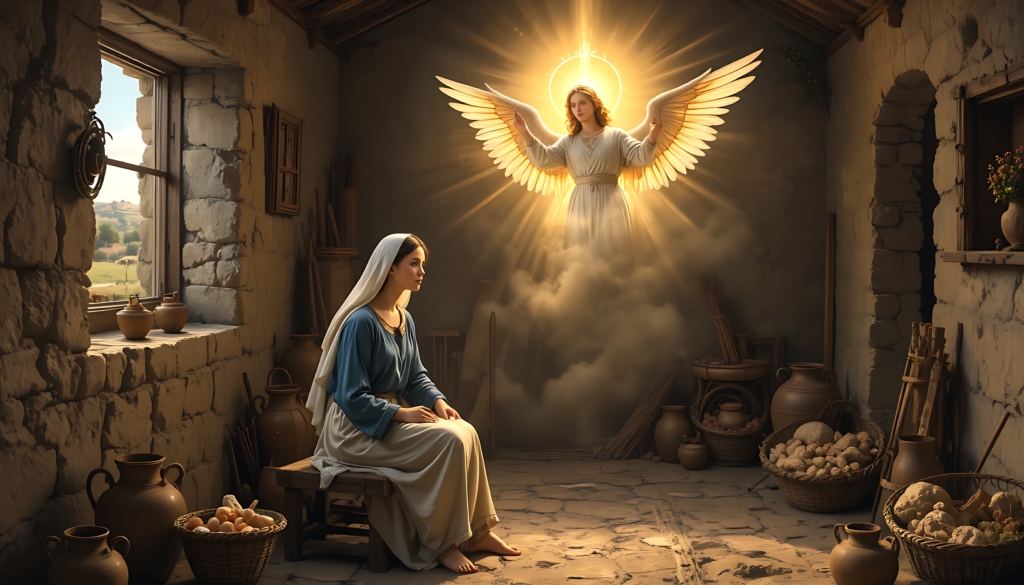
The story of Mary the mother of Jesus, unfolds quietly but powerfully. When you read the Bible story of Mary, the mother of Jesus, you see a life shaped by faith at every stage, not just one moment.
The Angel Gabriel Visits Mary
This moment is known as the Annunciation. The angel Gabriel appears to Mary and tells her she will give birth to the Messiah. At first, she is troubled and confused. This event was not part of her plan, and the social risk was real.
Yet she responds with faith instead of fear:
"I am the Lord's servant… May your word to me be fulfilled." (Luke 1:38)
This passage shows her willingness to trust God even when the future feels uncertain.
You may want to check out this post: Who Was Elizabeth in the Bible? Her Story and Role
Mary Visits Elizabeth
After this, Mary visits her relative Elizabeth. This moment brings confirmation. Elizabeth recognizes that Mary is carrying the promised child.
"Blessed are you among women, and blessed is the child you will bear!" (Luke 1:42)
Mary’s faith grows stronger here. She is no longer alone in what she is facing.
You may want to check out this post: Who Was Hannah in the Bible? Her Story, Prayer, and Faith
The Birth of Jesus
Mary travels to Bethlehem with Joseph, where Jesus is born in simple, humble circumstances. There is no comfort or status, just obedience and trust.
"She gave birth to her firstborn, a son… and placed him in a manger." (Luke 2:7)
Even in this moment, Mary stays grounded, taking it all in quietly.
You may want to check out this post: Who Was Mary of Bethany in the Bible? Her Story and Role
Mary During Jesus’ Ministry
As Jesus grows and begins his ministry, Mary is not always in the spotlight. Still, she is present. At times, she does not fully understand what Jesus is doing, but she continues to follow and stay connected.
Her role shifts from raising him to watching God’s plan unfold.
Mary at the Cross and After
One of the hardest moments comes at the cross. Mary watches her son suffer and die. She does not turn away.
"Near the cross of Jesus stood his mother…" (John 19:25)
Even in deep pain, she stays. After the resurrection, she is seen again in Acts 1, praying with the disciples. She remains part of what God is doing.
This entire journey shows that Mary’s faith was not just a single decision. It was a lifetime of trusting God step by step.
You may want to read this post: Who Is Eve in the Bible? Creation, Fall, and Key Verses
The Historical and Cultural Context of Mary’s Life
To understand Mary clearly, we need to look at Nazareth in biblical times. Nazareth was a small, simple village in Galilee. Life was calm and simple. Most people lived close to the land, and news spread fast. In a place like this, a person’s reputation mattered a lot.
The Jewish marriage customs Mary lived under were very strict. Engagement, often called betrothal, was legally binding. Even before living together, a couple was considered committed. Breaking that bond could bring serious consequences.
This connects directly to the social risk of Mary’s pregnancy. When Mary became pregnant before living with Joseph, people would have assumed unfaithfulness. In that culture, such an act could lead to public shame, rejection, or worse. Her situation was not just surprising; it was dangerous.
The role of women in first-century Israel was also limited. Women were expected to focus on family life, stay within social boundaries, and protect the honor of their household. They were not usually given public roles or authority.
In this setting, Mary’s response stands out even more. She accepted God’s plan, knowing the cost. She stepped into a path that could damage her reputation and future. Her faith was not just personal. It went against social expectations and required real courage in a culture that left little room for mistakes.
You may want to check out this post: Who Is Sarah in the Bible? Her Story, Faith, and God’s Promise
Why Was Mary Chosen to Be the Mother of Jesus?
Many people ask, “Why was Mary chosen to be the mother of Jesus?” The Bible does not point to status, wealth, or influence. It shows a different reason instead. When the angel greets her, he says she is “favored by God” (Luke 1:28). This phrase does not mean she was perfect. It means God chose her for His purpose.
So, what qualified Mary to be the mother of Jesus? Her answer is the most clear. When she hears the message, she says:
"I am the Lord's servant… May your word to me be fulfilled." (Luke 1:38)
This is a simple but powerful picture of Mary’s obedience to God. She does not demand details. She does not delay. She trusts God before she understands everything.
We also see Mary’s humility in the Bible, as she views herself. In her song, she says:
"He has been mindful of the humble state of his servant." (Luke 1:48)
God often works this way. He picks people who are willing to help, not people who look strong to the world. Mary’s life shows that being open to God matters more than having all the answers.
Her story reminds us that God’s calling can come at unexpected times. The key is to be ready to say yes, even when the way is unclear.
You may want to read this post: Who Was Rebekah in the Bible? Her Story in Genesis and Life of Faith
What Does Mary’s Song (Magnificat) Mean?
The Magnificat of Mary is found in Luke 1:46–55, where Mary responds to God with a song of praise. This moment, often called the Magnificat, shows her heart clearly. In this Mary song (Luke 1 explanation), we see not just joy, but deep trust in who God is.
"My soul glorifies the Lord and my spirit rejoices in God my Savior…" (Luke 1:46–47)
Mary begins by praising God, not herself. She recognizes that God has noticed her humble position and chosen her for His purpose. This gesture shows that you are humble. She knows that the situation isn’t about her position but about God’s love.
As the song continues, Mary speaks about justice. She says:
"He has brought down rulers from their thrones but has lifted up the humble." (Luke 1:52)
This verse shows that God sees both pride and suffering. He acts in ways that turn things around.
She also highlights God’s faithfulness.
"He has helped his servant Israel, remembering to be merciful." (Luke 1:54)
Mary connects her story to God’s past promises. She trusts that God will do what He said He would do.
Why does this story matter today? Mary’s song reminds us that God values humility, keeps His promises, and sees those who feel overlooked. Her words still speak to anyone learning to trust God in uncertain moments.
You may want to check out this post: Who Was Rachel in the Bible? Story, Marriage, and Meaning
The Role of Mary the Mother of Jesus, in God’s Plan

The role of Mary, the mother of Jesus, is deeply connected to God’s bigger story of redemption. She was not just part of one event. She was in a very important time in history when God’s promises were coming true.
One clear link is prophecy. Isaiah 7:14 says:
"The virgin will conceive and give birth to a son and will call him Immanuel."
This verse points forward to Jesus, and we see Mary fulfilling the prophecy when she carries out this promise in her life.
Her role was to bring the Messiah into the world. This was not an easy job. Through her, Jesus took on human life. Her role is central to Mary and God’s plan of salvation. Without this step, the story of redemption would not unfold the same way.
At the same time, Mary’s role was not about power or position. It was about being willing. She carried Jesus, raised him, and stayed with him through his life, even at the crucifixion. She witnessed both the promise and the pain.
Her place in salvation history shows how God works through real people. Mary’s life reminds us that even a quiet, faithful “yes” can become part of something far greater than we can see.
You may want to read this post: Who Was Leah in the Bible? Story, Sons, and Her Role in God’s Plan
Timeline of Mary the Mother of Jesus in the Bible
The timeline of Mary the mother of Jesus, helps you see her full journey, not just one moment. This timeline of Mary’s life in the Bible shows how her faith remained steady through every stage.
Before Jesus’ birth
Mary lives in Nazareth and is engaged to Joseph. The angel Gabriel appears and informs her she will give birth to the Messiah. She accepts God’s plan with faith (Luke 1).
Birth and childhood
Mary gives birth to Jesus in Bethlehem under simple conditions. She raises him and reflects on the events surrounding his early life (Luke 2:7, 19).
Ministry years
As Jesus begins his public ministry, Mary steps into a quieter role. She is present at key moments, even when she does not fully understand everything (John 2:1–5).
Crucifixion
Mary stands at the cross, watching Jesus’ suffering. She remains there in one of the most painful moments of her life (John 19:25).
Early church
After the resurrection, Mary is with the disciples, praying and waiting. She is part of the early church (Acts 1:14).
This timeline shows that Mary’s faith was not just for one season. It stayed strong from the beginning to the very end.
You may want to read this post: Who Was Martha in the Bible? Her Story and Role
What Can We Learn from Mary’s Faith?
There are simple but powerful lessons from Mary, the mother of Jesus, that still speak to real life today. When we look at Mary’s faith in the Bible, we don’t see a perfect life. We see a steady trust in God through both joy and pain.
1. Trust God even when you don’t understand
Mary did not have all the answers when the angel spoke to her. Still, she chose to believe.
"May your word to me be fulfilled." (Luke 1:38)
Her story reminds us that faith often comes before clarity.
2. Say yes to God’s calling
Mary’s yes changed everything. It wasn’t easy, but it was ready. This moment is a clear picture of Mary’s surrender to God. She did not control the outcome. She simply trusted God with it.
3. Stay faithful in hard moments
Mary was there not only at Jesus’ birth but also at his death.
"Near the cross of Jesus stood his mother…" (John 19:25)
She did not walk away when things became painful.
4. Live with quiet strength
Mary did not seek attention. She lived with a calm, steady faith.
"Mary treasured up all these things and pondered them in her heart." (Luke 2:19)
Her life shows that real faith is not loud. It is consistent. It stays, trusts, and follows God step by step, even when the path feels uncertain.
How Different Christians View Mary
Christians from different traditions honor Mary, but they understand her role in slightly different ways. Most agree that God chose the Virgin Mary for a unique purpose and showed deep faith and obedience.
In Catholic and Orthodox traditions, Mary is often called the “Mother of God,” a title that points to Jesus’ identity as fully God and fully human. She is highly honored and remembered in prayer and tradition.
In many Protestant churches, Mary is respected as the mother of Jesus and a strong example of faith, but she is not given the same level of focus in worship.
Even with these differences, there is a shared belief at the center. Mary was chosen by God and responded with trust, making her an important figure for all Christians.
Frequently Asked Questions About Mary the Mother of Jesus
How old was Mary when she had Jesus?
The Bible does not give her exact age. Based on Jewish culture at the time, many scholars believe Mary was likely a teenager, possibly between 13 and 16 years old, when Jesus was born.
Did Mary have other children?
The Gospels mention Jesus’ brothers and sisters (Mark 6:3, Matthew 13:55–56). Some understand this passage to mean Mary had other children, while others believe these were relatives or step-siblings. Different people have different ideas on this issue because the Bible doesn’t make it explicit.
What happened to Mary after Jesus died?
Mary appears with the disciples in Acts 1:14, praying and waiting after the resurrection. After that, the Bible provides no clear details about her later life.
How did Mary the mother of Jesus die?
Scripture does not record how Mary died. Later traditions offer different accounts, but there is no clear biblical description of her death.
How long did Mary live after Jesus died?
The Bible does not say. Some traditions suggest she lived for several years after the resurrection, but this theory is not confirmed in Scripture.
Final Thoughts on Mary the Mother of Jesus
The life of Mary the mother of Jesus, is simple on the surface but deeply meaningful when you look more closely. God chose her not because of her status, but because she was willing to do what he asked. From the moment she said yes to the moment she stood at the cross, her life showed steady faith, humility, and quiet strength.
Mary’s story invites us to reflect on our response to God. She trusted Him without having all the answers. She stayed faithful when things were hard. She followed through, even when the path brought pain. That kind of faith is still relevant today.
When you look at a list of women in the Bible, Mary stands as one of the clearest examples of what it means to trust God fully. Her role was special, yet everybody may benefit from her faith.
Think about where you are in your life right now. What would it look like to trust God the way Mary did?
If you want to go deeper, read more on other Women of the Bible and see how God works through ordinary lives in powerful ways.