
Rachel in the Bible
Rachel in the Bible was the beloved wife of Jacob, the daughter of Laban, and the sister of Leah. She is known for her deep love story, her struggle with infertility, and being the mother of Joseph and Benjamin, two important figures in the history of Israel.
Who Is Rachel in the Bible? Introduction to Her Story
Have you ever wondered why some women in the Bible are remembered for their feelings, like love, jealousy, longing, and waiting? If you’ve ever asked, “Who is Rachel in the Bible?” you’re stepping into one of the most emotional stories in Scripture.
In the Bible, Rachel appears in the Book of Genesis (chapters 29–35) as a central figure in the family that would become the twelve tribes of Israel. She is one of the most well known female Bible characters, loved by Jacob and remembered for both her beauty and her struggles.
Her life is a mix of deep love and painful challenges. Though she was Jacob’s chosen wife, she faced years of infertility, family rivalry, and emotional pain. Her story reflects real struggles many people still face today.
Among biblical matriarchs, Rachel stands out because her journey feels honest and relatable. It connects with themes seen throughout many Bible stories, such as waiting on God, dealing with comparison, and trusting His timing.
In fact, interest in Bible stories like Rachel’s is growing. A 2025 report by the American Bible Society found that 41% of U.S. adults actively engage with the Bible, with many seeking meaning in stories like hers.
As you follow her story, you’ll see not just history, but a life that still speaks to the heart today.
Quick Facts About Rachel in the Bible
- Who she was: Rachel was the beloved wife of Jacob and the daughter of Laban.
- Family: She was Leah’s sister.
- Children: Rachel gave birth to Joseph, who played a major role in Egypt, and Benjamin.
- Life events: Jacob worked for 14 years to marry her. She struggled with barrenness for many years and died giving birth to Benjamin.
- Legacy: Rachel is remembered as a key matriarch in Israel, symbolizing faith, perseverance, and God’s timing.
- Burial: She was buried near Bethlehem, at the site known today as Rachel’s Tomb.
- Themes: Love, rivalry with Leah, waiting on God, and trust in His plans.
You may want to read this post: Who Was Rebekah in the Bible? Her Story in Genesis and Life of Faith
The Story of Rachel in the Bible (Genesis Narrative)
The story of Rachel in the Bible unfolds across Genesis 29–35 and reads like a deeply human journey filled with love, heartbreak, waiting, and God’s timing. The Rachel in the Bible story is not just about romance. It is about how faith is tested in real life. From a beautiful love story to painful family tension, Rachel’s life shows how God works even through messy situations.
Jacob Meets Rachel and Falls in Love (Genesis 29)
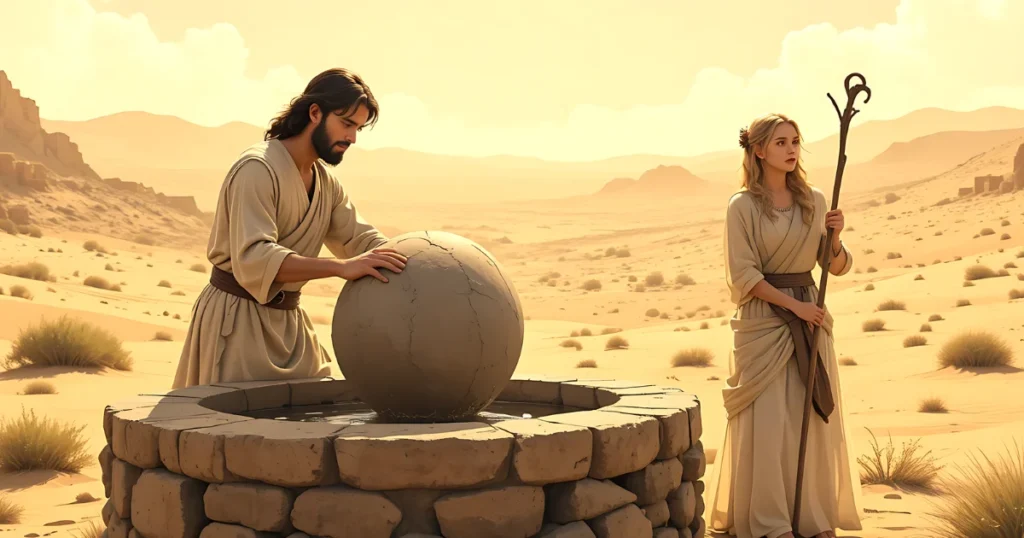
The moment Jacob and Rachel meet in the Bible feels almost cinematic. Jacob arrives at a well in Haran and sees Rachel approaching with her father’s sheep (Genesis 29:9–11). It is love at first sight.
He is so deeply affected that he personally rolls the stone away from the well and kisses her. That moment sets the tone for everything that follows.
Jacob agrees to work for Laban, Rachel’s father, in exchange for her hand in marriage. The Bible says:
"Jacob served seven years to get Rachel, but they seemed like only a few days to him because of his love for her." (Genesis 29:20, NIV)
This passage shows the depth of his love. Those seven years did not feel like a burden. They felt light since Rachel was everything to him. It is one of the most striking examples of devoted love in the Bible.
You may want to check out this post: Who Was Hagar in the Bible? Her Story, Faith, and the Birth of Ishmael
The Marriage Deception and Leah’s Role
Just when everything seems perfect, the story takes a sharp turn. Laban tricks Jacob on their wedding night by giving him Leah instead of Rachel.
This moment introduces the complicated dynamic of Leah and Rachel in the Bible. Jacob wanted to marry Rachel, but he woke up married to her older sister.
Laban then makes a deal. Jacob can marry Rachel, too, but only if he agrees to work another seven years. So, the answer to the question of who married Rachel in the Bible is Jacob, but it cost a lot. Fourteen years of work in all.
From this point on, tension grows. Jacob definitely loves Rachel more, and that preference causes competition, insecurity, and emotional misery in the family.
You may want to read this post: Who Is Sarah in the Bible? Her Story, Faith, and God’s Promise
Rachel’s Struggle with Barrenness (Genesis 30)
While Leah begins having children, Rachel remains unable to conceive. Rachel’s barrenness becomes one of the most painful parts of her story.
Scripture captures her desperation:
"Give me children, or I'll die!" (Genesis 30:1, NIV)
This request is not just a dramatic statement. It reflects the deep emotional and cultural weight she carried. In that time, barrenness was seen as shameful, and a woman’s worth was often tied to motherhood.
If you’ve ever wondered why was Rachel barren in the Bible, Scripture does not give a biological reason. Instead, it reveals that God was working on a longer time scale.
Rachel’s struggle also fuels the rivalry with Leah. Jealousy, comparison, and frustration begin to shape their relationship. It is incredibly human, honest, and raw.
You may want to check out this post: Who Is Eve in the Bible? Creation, Fall, and Key Verses
God Remembers Rachel and Gives Her Children
After years of waiting, everything changes.
"Then God remembered Rachel; he listened to her and enabled her to conceive." (Genesis 30:22, NIV)
This moment is powerful. God did not forget about her. He was waiting for the right time.
Rachel gives birth to Joseph, saying God has taken away her disgrace. Later, she had a baby boy named Benjamin. The moments when Rachel gives birth to Joseph and Benjamin mark the turning point of her story and her legacy in Israel’s history.
You may want to read this post: Who Was Hannah in the Bible? Her Story, Prayer, and Faith
Rachel’s Death and Burial (Genesis 35)
The story ends on a bittersweet note. If you’ve ever asked how Rachel died in the Bible, it happened during childbirth.
"As she breathed her last—for she was dying—she named her son Ben-Oni." (Genesis 35:18, NIV)
Jacob buried Rachel near Bethlehem after she died while giving birth to Benjamin. So, where was Rachel buried in the Bible? Scripture tells us it was on the way to Ephrath (Bethlehem).
Her life ends in sorrow, but her legacy lives on through her sons and the tribes of Israel.
You may want to check out this post: The Story of Ruth in the Bible Explained: Summary, Key Verses, and Meaning
Key Bible Verses About Rachel Explained
To truly understand Rachel in the Bible, we need to look closely at the verses that shape her story. These moments reveal her love, her struggle, and how God worked through her life in His perfect timing.
Genesis 29:18 (NIV)
"Jacob was in love with Rachel and said, 'I'll work for you seven years in return for your younger daughter Rachel.'"
This verse captures the depth of Jacob’s love. It was not shallow or rushed. He was willing to wait and work for years simply to be with her. It reminds us that real love frequently means being patient, giving up something, and sticking with it.
Genesis 30:1 (NIV)
"When Rachel saw that she was not bearing Jacob any children, she became jealous of her sister. So she said to Jacob, 'Give me children, or I'll die!'"
Here, we see Rachel’s pain in an honest way. Her struggle with infertility led to jealousy and desperation. This moment reveals that even though women in the Bible had feelings. God does not hide human weakness. He joins us there.
You may want to read this post: Who Was Mary the Mother of Jesus in the Bible? Her Story and Role
Genesis 30:22 (NIV)
"Then God remembered Rachel; he listened to her and enabled her to conceive."
This event is a turning point for Rachel in the Bible story. God had not forgotten her. He did it deliberately, even if the timing was odd. This verse teaches that waiting seasons are not wasted. God sees, hears, and answers at the perfect time.
Genesis 35:19 (NIV)
"So Rachel died and was buried on the way to Ephrath (that is, Bethlehem)."
Rachel’s story ends with sorrow, but also with legacy. Her life shows us that God’s plan goes on even when we lose someone. She became part of the lineage of Israel, and her story still speaks to faith, endurance, and hope.
You may want to read this post: Who Is Esther in the Bible? Story, Key Verses, and Meaning
Historical and Cultural Context of Rachel’s Life
To fully understand Rachel in the Bible, we need to step into the world she lived in. Her story makes more sense when we look at the biblical marriage customs and the ancient Israel family structure of that time.
In Genesis, polygamy was practiced, even though it often led to tension and conflict. Jacob’s marriages to Leah and Rachel were typical of the time, but they caused emotional issues in their story. Favoritism among wives often led to rivalry, as Rachel’s life reflects.
Children were extremely important in ancient Israel. They were seen as a blessing from God and a way to continue the family line. A woman’s identity and safety were often linked to her capacity to bear children. This explains why Rachel’s barrenness brought deep pain and urgency.
There was also strong social pressure on women. Being unable to bear children could lead to shame and comparison, especially within a household like Rachel’s. Her story shows how these cultural expectations shaped her emotions, her decisions, and her relationship with God.
You may want to check out this post: Who Was Mary Magdalene in the Bible? First Witness of the Resurrection
Rachel and Leah in the Bible (Comparison and Conflict)
Rachel’s story cannot be separated from her sister’s. The Rachel and Leah rivalry is one of the most emotional and revealing parts of Genesis, showing how favoritism in the Bible can shape relationships in painful ways.
Rachel was loved, while Leah was fruitful. Jacob clearly favored Rachel, and Scripture does not hide that truth. But Leah, though less loved, was blessed with children early on. These circumstances made things quite different, which hurt. One loved but had difficulty conceiving. The other had children but longed for love.
This imbalance led to deep emotional tension. Rachel became jealous, while Leah sought validation through motherhood. Their competition even extended into naming their children, each expressing personal pain, hope, and longing through those names.
Yet, God was actively working in both of their lives. Leah became the mother of Judah, part of the lineage of Jesus. Rachel later gave birth to Joseph and Benjamin, key figures in Israel’s future.
Their story reminds us that God’s plan is not based on human favoritism. Even in conflict, comparison, and broken emotions, He is still building His purpose.
You may want to read this post: Who Was Deborah in the Bible? Judge and Prophetess of Israel
Why Is Rachel Important in the Bible?
So, why is Rachel important in the Bible? Her significance goes far beyond her personal story. Rachel plays a vital role in Israel’s lineage, shaping the future of God’s covenant people.
She is the mother of Joseph and Benjamin, two key figures among the twelve tribes of Israel. Joseph, in particular, becomes a key leader in Egypt, and God uses him to save his family from starvation. God protects the people. He promised to Abraham through him.
Rachel’s life is also deeply connected to God’s covenant plan. Even though she struggled with waiting and pain, she became part of the bigger story of redemption. Her sons carried forward the promise that would eventually impact generations.
As a biblical matriarch, Rachel reminds us that God often works through imperfect lives to fulfill His perfect purpose.
Theological Meaning of Rachel’s Story
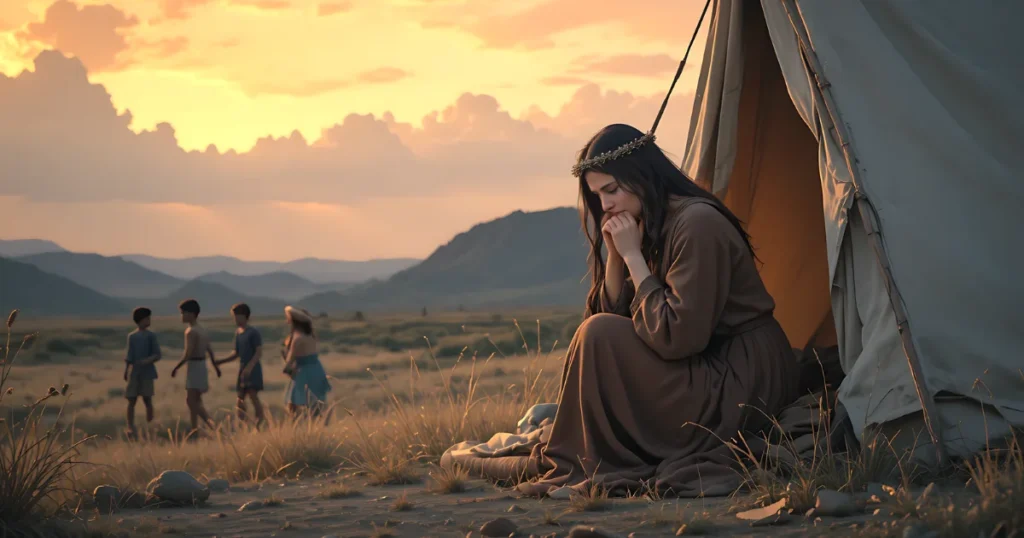
The story of Rachel in the Bible carries deep spiritual meaning that goes far beyond her personal struggles. At its core, her life reflects God’s timing in Scripture and the powerful theme of barrenness and blessing.
Jacob loved Rachel, yet she lived for years feeling overlooked because she could not have children. In contrast, Leah, who felt unloved, was fruitful. This reversal shows that God does not operate by human expectations. God observes the hurting, the neglected, and those who remain unseen.
Her long season of waiting teaches us about faith. Rachel’s journey was not instant. It was full of feelings, comparisons, and desire. But through it all, God was working behind the scenes. His timing was not off. It was intentional.
Rachel also represents the tension between human desire and God’s plan. She wanted control, quick answers, and relief from her pain. But God’s plan worked out differently. When he eventually gave her Joseph, it was apparent that the wait had been worth it.
Her story reminds us that even in seasons of silence, God is still writing something greater.
What Can We Learn from Rachel in the Bible?
So, what can we learn from Rachel in the Bible? Her life is deeply relatable, filled with emotions many of us still experience today. Rachel’s strength in the Bible lies not in perfection but in her persistence through pain, waiting, and unanswered questions.
First, Rachel teaches us about waiting on God. It took her years to become a mother. In a world that wants instant answers, her story reminds us that God’s timing is not rushed. It has a purpose.
Second, her life warns us about the dangers of comparison. The tension between Rachel and Leah in the Bible shows how dangerous it is to measure our lives against others. Many people still struggle with envy and emotional distress due to comparisons.
Third, Rachel shows us the importance of trusting God’s timing. Even when her prayers seemed unanswered, God was still working behind the scenes. Joseph’s birth indicated that waiting did not mean refusing.
Finally, Rachel’s story encourages emotional honesty. She did not hide her pain. She said it out loud. God meets us when we’re real with Him, not when we pretend to be strong.
Timeline of Rachel’s Life in the Bible
Understanding the timeline helps bring together key facts about Rachel in the Bible and shows how her story unfolds step by step in Genesis.
Rachel first appears when she meets Jacob at the well (Genesis 29). This moment marks the beginning of the famous love story of Jacob and Rachel in the Bible. Jacob agrees to work for her for seven years, but Laban tricks him into working for fourteen years instead.
Next comes her long season of waiting. Leah has kids, but Rachel can’t have kids, which is a sad time that shapes much of her story.
Eventually, God blesses her with two sons, Joseph and Benjamin, securing her place in the lineage of Israel.
Her story ends tragically but meaningfully, as she dies giving birth to Benjamin and is buried near Bethlehem, leaving behind a lasting legacy in Scripture.
Where Was Rachel Buried?
If you’ve ever wondered where Rachel was buried in the Bible, Scripture gives a clear answer. Rachel was buried near Bethlehem, on the way to Ephrath (Genesis 35:19). This site became known over time as Rachel’s tomb, a place remembered and honored for generations.
Her burial site holds deep historical and spiritual meaning. Bethlehem later becomes important as the birthplace of King David and ultimately Jesus Christ, connecting Rachel’s story to a much larger biblical timeline.
Jewish tradition has long recognized this site as a place of remembrance and prayer. Even today, Rachel’s tomb is considered one of the most important historical landmarks tied to the matriarchs of Israel.
FAQs About Rachel in the Bible
Why did Jacob love Rachel more than Leah?
Jacob loved Rachel more because he chose her from the beginning. His love began the moment he saw her at the well, and he worked for years willingly just to marry her. Trickery handed Leah to him. This deception created an emotional imbalance that shaped their entire family story.
How many years did Jacob work for Rachel?
Jacob worked a total of fourteen years for Rachel. He first agreed to work for seven years to marry her, but after Laban’s deception, he worked another seven years to finally marry her.
Who were Rachel’s children in the Bible?
Rachel had two sons, Joseph and Benjamin. Joseph later became a powerful leader in Egypt and helped save his family during the famine. Benjamin was the ancestor of one of the tribes of Israel, which kept Rachel’s memory alive.
Did Rachel struggle with comparison and jealousy?
Yes, Rachel struggled deeply with comparison, especially with her sister Leah. While Leah had children, Rachel remained barren for years. Such circumstances made people jealous and hurt their feelings. Her story reflects how comparison can affect our hearts, something many people still relate to today.
What does Rachel’s story teach about waiting on God?
Rachel’s life shows that waiting on God is not easy, but it is meaningful. She waited years to have kids, but God answered her at the proper time. Her story reminds us that delays are not denial. Even when we can’t see it, God is always at work.
How is Rachel remembered in later Scripture?
Rachel is remembered in later Scripture as a symbol of sorrow and mourning. In Jeremiah 31:15, she is described as weeping for her children. This image shows how her story continued to evoke serious emotion and a sense of connection with the people of Israel.
Final Thoughts on Rachel in the Bible
Rachel’s story stays with you. It’s not tidy. It’s not a simple moral with a neat bow. It’s real life, written down for us to find ourselves in.
She was deeply loved but deeply wounded. Favored by her husband but forgotten by her body for years. She had moments of faith and moments of total meltdown. She laughed. She cried. She schemed. She stood there. She finally held her babies, then left them too soon.
Women in the Bible, like Rachel, matter because they’re us. They’re not perfect statues. They’re real people who stumbled through life while God quietly wove their mess into His plan. Rachel’s jealousy, her desperation, her cries at night—God saw it all and still chose her to build the nation of Israel.
Her lasting impact? Two tribes. The lineage of the Messiah. A tomb near Bethlehem that still stands. Matthew’s narrative echoes a lament in Jeremiah. Rachel didn’t merely live and die. She became a part of the story of redemption itself.
If you want to keep going, refer to the complete list of women of the Bible on this site. Sarah’s laughter. Rebekah’s boldness. Leah’s hurt. Hannah’s prayer. Esther’s courage. Mary’s surrender. They’re all waiting for you.
Rachel’s story reminds us of one thing: God doesn’t wait for perfect people. He works through real ones. People like Rachel. People like you.