

Who Was Jochebed in the Bible? An Introduction to Moses’ Faithful Mother
In the Bible, Jochebed was a faithful Levite woman, the wife of Amram, and the mother of Moses, Aaron, and Miriam. Although she is mentioned by name only a few times in Scripture, her courageous faith and trust in God helped preserve the life of Moses, the future deliverer of Israel. Her account is found mainly in Exodus 2, with additional references in Exodus 6:20, Numbers 26:59, and Hebrews 11:23. When asking, “Who was Jochebed in the Bible?” the answer reveals much more than just a family record. She became an example of faith, wisdom, and obedience during one of Israel’s darkest times.
Among the remarkable women of Scripture, Jochebed stands out for trusting God when fear surrounded her family. Living under Pharaoh’s order to kill every Hebrew baby boy, she chose courage instead of despair. Her decision impacted the trajectory of Israel’s history and became part of God’s plan to deliver His people from bondage.
In this guide, you’ll learn about Jochebed’s family, the meaning of her name, the key Bible passages about her, her place in the list of Women in the Bible, and the practical lessons Christians can apply from her life today.
Jochebed in the Bible at a Glance (Quick Facts)
Whether you’re beginning a Bible study or reading a character study of the women of the Bible, this overview provides the most important facts about Jochebed. Although Scripture records only a few details about her life, those details reveal a woman whose faith influenced generations. Understanding these facts helps place Jochebed in the Bible within the larger story of God’s plan to rescue Israel from slavery.
Quick Facts About Jochebed
| Fact | Details |
|---|---|
| Meaning of her name | Jochebed (Hebrew: Yokheved) means “Yahweh is glory” or “The Lord is my glory.” Her name reflects devotion to the God of Israel. |
| Bible references | Exodus 2:1 to 10, Exodus 6:20, Numbers 26:59, Hebrews 11:23, Acts 7:20 |
| Husband | Amram, a Levite (Exodus 6:20) |
| Children | Miriam, Aaron, and Moses |
| Tribe | Tribe of Levi |
| Place of residence | Egypt, where the Israelites lived during their years of slavery |
| Time period | During Israel’s bondage in Egypt, before the Exodus |
| Known for | Protecting baby Moses from Pharaoh’s decree and trusting God with his future |
| Main biblical event | Hiding Moses for three months, then placing him in a waterproof basket among the reeds of the Nile River, where Pharaoh’s daughter found him (Exodus 2:1 to 10) |
| Key character qualities | Faith, courage, wisdom, obedience, trust in God, and sacrificial love |
These facts explain why Jochebed is one of the most renowned women in the Old Testament. She lived in an age of dread and injustice, yet chose faith over panic. Her deed saved the life of the man God would later use to lead Israel out of Egypt. Even though the Bible tells us little about her daily life, every recorded detail points to God’s providence and the lasting impact of faithful obedience.
As you continue this study, you may also enjoy reading about Miriam, Jochebed’s courageous daughter who watched over baby Moses, and Shiphrah, one of the Hebrew midwives whose reverence for God helped protect Hebrew children before Moses was born. These women together provide a picture of how God used ordinary people to bring about His extraordinary plans.
What Does Jochebed Mean in the Bible?
The meaning of Jochebed derives from the Hebrew name Yokheved, commonly understood to mean “Yahweh is glory” or “The Lord is my glory.” The meaning of Jochebed in the Bible points directly to God’s covenant name, Yahweh, and reminds readers that true honor is his. Names are often spiritually important in the Bible. They may reveal a person’s identity, God’s purpose, or an essential truth about His dealings with His people.
Jochebed’s life reflected the meaning of her name. During a time when Pharaoh tried to destroy every Hebrew baby boy, she trusted God instead of giving in to fear. With wisdom, courage, and trust, she hid Moses and then placed him in a meticulously constructed basket on the Nile River. Her choices brought glory to God because they showed confidence in His protection and His plan, even when the future seemed uncertain.
Like many faithful women in the Bible, Jochebed reminds us that a life devoted to God often has a greater impact than many words. Her example stands alongside that of women such as Zipporah and Deborah, who also trusted the Lord and played important roles in His unfolding plan for Israel. Their lives together reveal how faithful obedience can leave a lasting spiritual legacy.
Jochebed’s Family and Historical Background
Understanding Amram and Jochebed in the Bible helps us see how God prepared a family that would play a central role in Israel’s history. If you’ve ever wondered, “Who is the father and mother of Moses in the Bible? Who are the parents of Moses? Or who was Moses’ mother?” Scripture gives a clear answer. Moses’ parents were Amram and Jochebed, both from the tribe of Levi (Exodus 6:20).
Their family lived during one of the darkest periods in Israel’s history, yet God used their faith to begin His plan of deliverance. This background also helps explain why Jochebed remains one of the most inspiring women in Scripture for believers seeking to grow in their Christian faith through careful study.
Jochebed’s Family and Genealogy
Jochebed was a Levite identified in Scripture as a descendant of Levi (Numbers 26:59). So you had a family set apart for God’s purposes long before the priesthood was established. She married a fellow descendant of the tribe of Levi, Amram.
Together, Amram and Jochebed became the parents of three remarkable children. Miriam, their eldest, was to become a prophetess. Aaron was the first high priest for Israel. Moses was the leader God chose to lead His people out of Egypt. At the time of their births, however, they were simply children born into slavery, with no visible sign of the extraordinary future God had prepared for them.
Looking back, it becomes clear that God was quietly working through this ordinary family to accomplish His covenant promises to Abraham, Isaac, and Jacob.
Life in Egypt Under Pharaoh’s Rule
Jochebed lived during a period when the Israelites had become enslaved people in Egypt. After Joseph’s generation passed away, a new Pharaoh came to power who “did not know Joseph” (Exodus 1:8, NIV). The Hebrews continued to multiply, and Pharaoh feared they might become too numerous and join Egypt’s enemies in war. To maintain control, he forced the Israelites into harsh labor and bitter slavery.
When oppression failed to slow their growth, Pharaoh issued an even more terrible command. Every newborn Hebrew boy was to be killed, while the girls were allowed to live (Exodus 1:22). This decree created constant fear for every Hebrew family and set the stage for Jochebed’s courageous decision to protect her infant son.
This historical setting is essential to understanding why the mother of Moses in the Bible is remembered for her faith. Hiding Moses was not merely an act of parental love. It was an act of trust in God at a time when obedience carried enormous risk. Her courage became the beginning of God’s rescue plan for Israel, proving that He often works through faithful people during the darkest moments of history.
Jochebed’s story also connects naturally with the lives of Rahab, Hannah, and Elizabeth, women who trusted God in difficult circumstances and witnessed His faithfulness in remarkable ways.
The Story of Jochebed in the Bible
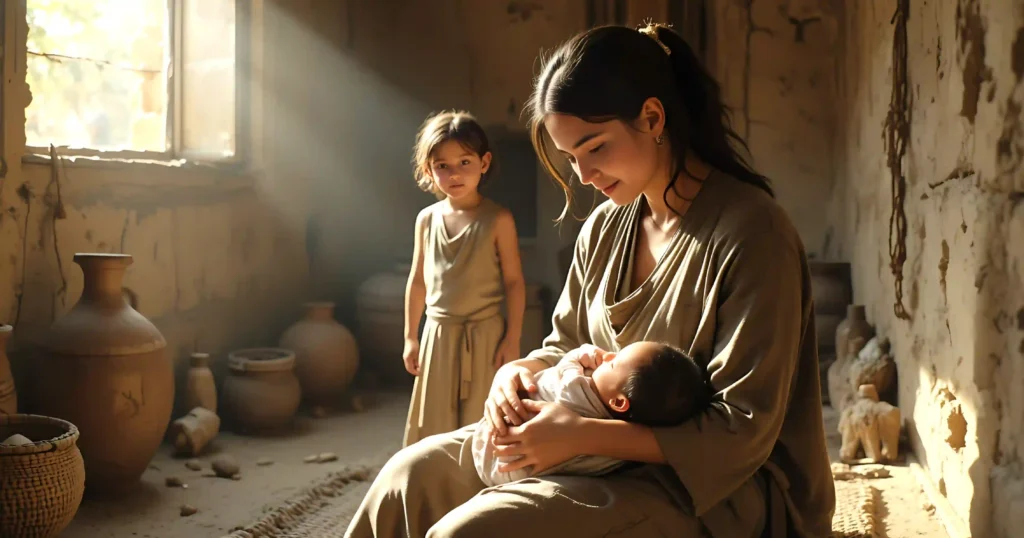
The story of Jochebed in the Bible is one of quiet courage, wise action, and unwavering trust in God. Although she speaks no recorded words, her decisions changed the course of Israel’s history. If you have ever wondered, “Where is the story of Jochebed in the Bible?”
The main account appears in Exodus 2:1-10, with additional references in Exodus 6:20, Numbers 26:59, Hebrews 11:23, and Acts 7:20. Together, these passages provide a rich character study and reveal why Jochebed remains one of the most remarkable figures in the story of women in the Bible.
Jochebed Hid Baby Moses by Faith (Exodus 2:1-3)
The Bible introduces Jochebed during a time of great danger. Pharaoh had ordered that every Hebrew baby boy should be thrown into the Nile River. Despite this cruel law, Jochebed gave birth to a healthy son and chose to protect him instead of surrendering him.
The Scripture says:
“When she saw that he was a fine child, she hid him for three months.” (Exodus 2:2, NIV)
Jochebed knew she could not hide Moses forever. As he grew older, it was impossible to keep him secure in the house. But those three months were a display of incredible courage. Every day she risked discovery, trusting that God would make a way even when she could not see the outcome.
The New Testament highlights her faith in Hebrews:
“By faith Moses’ parents hid him for three months after he was born, because they saw he was no ordinary child, and they were not afraid of the king’s edict.” (Hebrews 11:23, NIV)
This verse reminds us that Jochebed’s actions were motivated by faith, not by fear. She did not dispute the danger around her. No, she knew God’s designs were stronger than Pharaoh’s authority.
Her example teaches that trusting God does not always remove difficult circumstances. Sometimes faith means taking the next faithful step while leaving the results in God’s hands. Jochebed couldn’t control the Pharaoh of Egypt, but she could choose to obey and believe.
Placing Moses in the Basket on the Nile (Exodus 2:3 to 10)
When Jochebed could no longer hide Moses, she carefully prepared a papyrus basket coated with tar and pitch so it would float on the water. The Bible describes this container using the same Hebrew word translated “ark” elsewhere, reminding readers of Noah’s ark, another vessel through which God preserved life.
She placed the basket among the reeds along the Nile River rather than sending it into the strong current. This was not a desperate measure. In prayerful trust, it was a wise strategy. Jochebed believed God could protect her son even after she released him from her hands.
Miriam, Moses’ older sister, stood nearby to watch what would happen. Soon Pharaoh’s daughter came to the river to bathe and noticed the basket among the reeds. She opened it, and when she saw the wailing infant, she felt sympathy for him, for she perceived that he was one of the Hebrew children.
At that moment, Miriam approached her and wisely offered to find a Hebrew woman to care for the child. Pharaoh’s daughter agreed, and Miriam fetched Jochebed.
Scripture says:
“Take this baby and nurse him for me, and I will pay you.” (Exodus 2:9, NIV)
What an extraordinary turn of events. Jochebed not only received her son back, but she was also paid to care for him during his early years. God blessed her faith in ways she could never have imagined.
This account beautifully illustrates God’s providence. He worked through ordinary events and unexpected people, including Pharaoh’s own daughter, to preserve the future deliverer of Israel.
Jochebed’s Later Mentions in Scripture
Although the main narrative ends after Moses’ early childhood, Jochebed appears several more times in the Bible. Every reference adds a vital detail to her story.
Exodus 6:20 identifies Jochebed as Amram’s wife and the mother of Aaron and Moses.
“Amram married his father’s sister Jochebed, who bore him Aaron and Moses.” (NIV)
This verse places her within Israel’s genealogy and confirms her role in the family God used to lead His people.
Numbers 26:59 provides additional family details, identifying Jochebed as a descendant of Levi.
“The name of Amram’s wife was Jochebed, a descendant of Levi.” (NIV)
This reminder connects Moses’ family to the tribe that would later become responsible for serving in the tabernacle.
Hebrews 11:23 honors Jochebed and Amram for their faith. Rather than focusing only on Moses, this passage recognizes the courageous parents who trusted God before Moses ever led Israel. Their faith was added to the Bible’s great list of committed believers.
Acts 7:20, in Stephen’s speech before the Sanhedrin, briefly recalls Moses’ birth.
“At that time Moses was born, and he was no ordinary child. For three months he was cared for by his family.” (NIV)
This verse reminds readers that God’s saving work began long before the plagues and the crossing of the Red Sea. It began with a faithful family willing to trust Him under impossible circumstances.
Jochebed’s account may be brief, but its impact reaches across the whole Bible. Like Vashti, who made a courageous choice in a difficult moment, and Tabitha (Dorcas), whose faithful life blessed many people, Jochebed shows that God often uses ordinary acts of obedience to accomplish extraordinary purposes. Her story continues to encourage believers to trust God’s care, even when they cannot yet see His plan.
What Happened to Jochebed After Moses Returned?
Many readers wonder what happened to Jochebed after she was reunited with her son. The Bible tells us that Pharaoh’s daughter entrusted baby Moses to Jochebed to nurse and care for him (Exodus 2:9). After he was old enough, Jochebed brought him back to Pharaoh’s daughter, who adopted him as her son. It is written:
“When the child grew older, she took him to Pharaoh’s daughter, and he became her son. She named him Moses, saying, ‘I drew him out of the water.'” (Exodus 2:10, NIV)
This verse suggests that Jochebed raised Moses during his earliest and most formative years. While the Bible does not say exactly how long he remained with her, many scholars believe she had valuable time to teach him about the God of Israel, his Hebrew identity, and the promises made to his ancestors. These thoughts are plausible, but they should not be declared as fact, since Scripture does not tell us these things.
After Moses entered Pharaoh’s household, the Bible records nothing more about Jochebed’s personal life. It does not extend to her later years or her death. Later Jewish traditions contain stories about her, but these lie beyond the biblical record and should be understood as tradition rather than historical fact.
This careful distinction reminds us to build our Christian faith on what Scripture clearly teaches. Her example speaks powerfully, even if we know nothing more of Jochebed’s life. Like faithful women throughout the Bible, including Susanna and Salome, she is remembered for her trust in God, which left a lasting spiritual legacy that reached far beyond her lifetime.

Why Is Jochebed Important in the Bible?
If you’ve ever asked, “Why is Jochebed important in the Bible?” the answer goes far beyond her role as Moses’ mother. Her account shows how God works through ordinary people who trust Him during extraordinary circumstances. Although Jochebed appears only a few times in Scripture, her faith helped preserve the child God had chosen to lead Israel out of slavery. Her life remains an important scripture study for anyone seeking to understand God’s faithfulness and the lasting influence of the women of the Bible.
One of the greatest qualities of Jochebed in the Bible is her faith. She refused to let Pharaoh’s decree determine her actions. She trusted God to protect her kid enough to protect him herself, even at the risk of her life, rather than giving in to fear. Her courage was not reckless. It was rooted in the confidence that God could care for her family.
Jochebed also demonstrated wisdom and obedience. She hid Moses for as long as possible and then placed him in a carefully prepared basket among the reeds of the Nile. Her plan showed thoughtful activity, yet she left the outcome in God’s hands. This balance between responsible action and trusting God is a valuable lesson for believers today.
Most importantly, Jochebed’s story reveals God’s providence and sovereign plan. Even before Moses met Pharaoh or led the Exodus, God was protecting the future deliverer of Israel through his mother’s unwavering obedience. Her quiet acts of faith became part of God’s greater work of redemption.
Jochebed also stands as a model of faithful motherhood. She loved her child dearly but trusted God with the things she couldn’t control. Like Ruth, whose loyalty reflected steadfast faith, and Rachel, whose family became part of God’s covenant story, Jochebed reminds us that ordinary acts of obedience can have an eternal impact when they are placed in God’s hands.
Lessons from Jochebed in the Bible
The lessons from Jochebed in the Bible continue to encourage believers today because they are rooted in real faith lived out during difficult circumstances. Although Jochebed lived centuries before the women in Jesus’ earthly ministry, her example points to the same God who remains faithful to His people in every generation.
Five Lessons Christians Can Learn From Jochebed
1. Trust God during uncertainty.
Jochebed could not predict what would happen to her son, yet she chose to trust God rather than let fear control her decisions. Faith doesn’t necessitate that we have all the answers. It begins with believing God is present even when the future is unclear.
2. Courage often requires action.
Jochebed did more than simply hope. She hid Moses, carefully prepared the basket, and trusted God with the outcome. Her story is a reminder that religion and meaningful works are often companions.
3. Parents influence future generations.
The years Jochebed spent caring for Moses mattered. While the Bible does not describe every conversation they shared, her faith and example became part of the foundation for a man whom God would use to lead an entire nation.
4. God works through ordinary believers.
Jochebed wasn’t a queen or a celebrity. She was an ordinary Hebrew mother living under oppression. Yet God used her obedience to accomplish His extraordinary purposes.
5. Faith leaves a lasting legacy.
Jochebed’s name appears only a handful of times in Scripture, but her influence reaches throughout the Bible. Her story is a reminder that a life of faithfulness can bless generations after we are gone. The same truth is evident in the lives of women such as Phoebe and Leah, whose trust in God also became part of His unfolding plan.
As a modern application, some Christians choose to pray a simple Jochebed prayer when facing situations beyond their control:
“Heavenly Father, help me trust You when I cannot see the future. Give me wisdom to act faithfully, courage to obey Your Word, and peace to place my loved ones in Your care. May my life point others to Your faithfulness and bring glory to Your name. Amen.”
This is not a prayer found in Scripture. It is simply a modern reflection inspired by Jochebed’s example of faith and trust in God.
Frequently Asked Questions About Jochebed in the Bible
Q1: Was Jochebed a Levite?
Yes. Jochebed belonged to the tribe of Levi and was part of a Levite family. Numbers 26:59 identifies her as a descendant of Levi, and Exodus 6:20 records that she married Amram, who was also a Levite. Aaron was the first high priest, and Moses was God’s chosen leader. Later, their family became the center of worship and leadership for Israel.
Q2: How many times is Jochebed mentioned in the Bible?
Jochebed is mentioned by name twice in the Bible:
Exodus 6:20, where she is identified as Amram’s wife and the mother of Aaron and Moses.
Numbers 26:59, which records her family background and confirms that she belonged to the tribe of Levi.
Although she is not named in Exodus 2:1-10, that passage tells her story as the mother who hid and protected baby Moses. The New Testament also refers to the faith of Moses’ parents in Hebrews 11:23, and Acts 7:20 recalls Moses’ birth and early care, even though Jochebed is not mentioned by name in those passages.
Q3: Why is Jochebed listed in the biblical account of Jesus even though she is not in his genealogy?
She is not listed in Jesus’ genealogy. The genealogies of Jesus in Matthew 1 and Luke 3 do not include Jochebed. This omission is a common misunderstanding because Jochebed played such an important role in God’s plan of salvation. She was not a direct ancestor in Jesus’s lineage, but she saved the life of Moses, the leader God employed to liberate Israel from bondage and through whom He gave the Law. Her faith became an essential part of Israel’s redemptive history, preparing the way for God’s covenant people and, ultimately, for the coming of the Messiah. For that reason, Jochebed remains one of the most significant women in the Old Testament, even though she is not included in Jesus’ genealogy.
Why Jochebed’s Story Still Inspires Christians Today
The account of Jochebed in the Bible reminds us that God often accomplishes His greatest purposes through ordinary people who trust Him. Jochebed never led a nation or stood before kings, yet her faithful choices helped preserve the life of Moses, the man God appointed to lead Israel out of slavery. Her example shows how even quiet obedience can be used in God’s greater plan.
Among the many women in the Bible, Jochebed stands as a lasting example of courage, wisdom, and faith. Her story encourages believers to trust God when the future seems uncertain and to remember that His care extends beyond what we can see.
If you’d like to understand her life more deeply, spend time reading Exodus 1 and 2, then continue with Hebrews 11:23 to see how the New Testament honors the faith of Moses’ parents. In these verses, we see God’s sovereign design and God’s faithful love from generation to generation.
For more encouraging Bible character studies, explore our Women of the Bible collection and learn how God worked through faithful women to accomplish His purposes throughout Scripture.