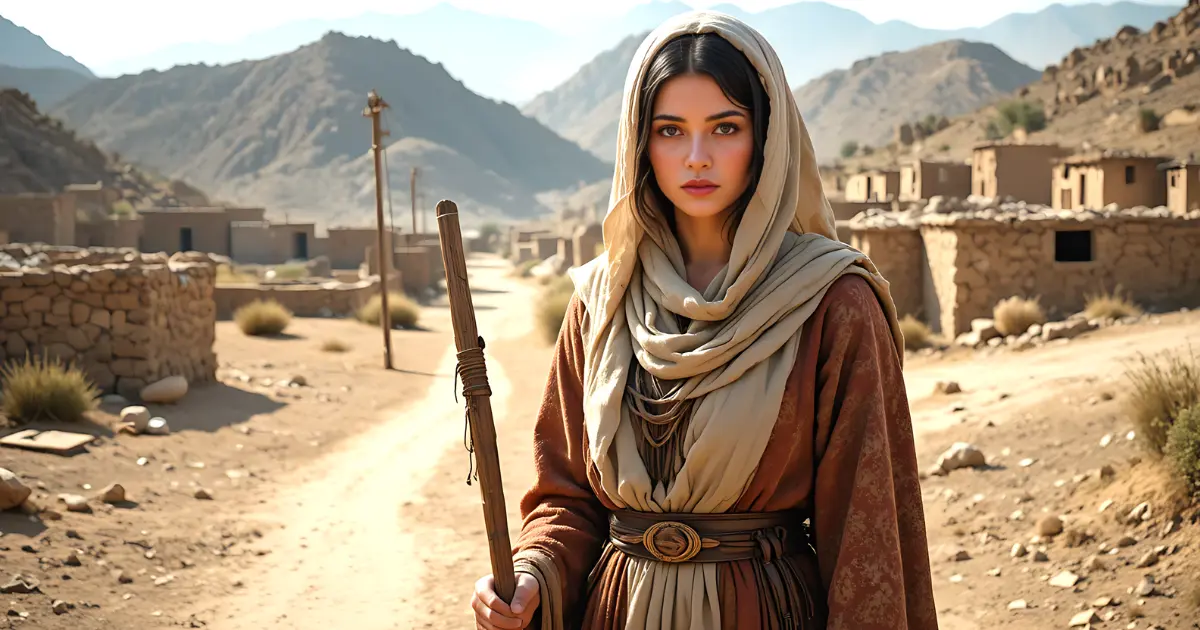
Who Was Tamar in the Bible?
Who was Tamar in the Bible? Tamar was the daughter in law of Judah, whose account is recorded in Genesis 38. The story of Tamar in the Bible centers on her fight to preserve her deceased husband’s family line. She later became the mother of Perez and Zerah, and her name appears in the genealogy of Jesus Christ in Matthew 1.
When many people think about Tamar in the Bible, they immediately notice how unusual and difficult her story is. Genesis 38 has familial grief, broken promises, social injustice, and an unexpected act that impacted the destiny of Israel’s history. Yet beneath the tension lies a powerful account of God’s providence and faithfulness.
Tamar entered Judah’s family as the wife of his oldest son, Er. After Er’s death and a series of events involving Onan and Shelah, Tamar found herself in a vulnerable position as a widow with little protection or security. Rather than disappearing from the biblical narrative, she became a key figure in preserving the family line of Judah, the tribe through which King David and ultimately Jesus Christ would come.
Among the many women in Scripture, Tamar stands out because her account challenges readers to look beyond appearances and consider God’s larger purposes. Her story poses serious questions about justice, righteousness, covenant commitments, and redemption. That is why her name still appears on practically every significant list of women in the Bible that Christians study today.
In the sections that follow, we’ll explore Tamar’s life, the events in Genesis 38, her place in Jesus’ genealogy, and the enduring faith lessons her story offers believers today.
Quick Facts About Tamar
Before diving deeper into the account, this quick reference guide highlights the most important facts about Tamar in the Bible. Although her story occupies only one chapter of Genesis, Tamar from the Bible played a crucial role in the family line that eventually led to Jesus Christ. Her story remains among the most studied in the Women of the Bible, as it includes familial sorrow, heroism, justice, and God’s greater plan of redemption.
| Fact | Details |
|---|---|
| Meaning of Tamar’s Name | “Tamar” means palm tree, a symbol often associated with beauty, fruitfulness, and strength. |
| Main Bible Passage | Genesis 38 |
| Family Connections | Daughter in law of Judah, son of Jacob |
| Husband(s) | Er (Judah’s firstborn), later connected to Onan through levirate marriage customs |
| Children | Perez and Zerah |
| Tribe Connection | Tribe of Judah |
| Key Event | Disguised herself and confronted Judah’s failure to provide Shelah as promised |
| Historical Setting | Patriarchal period during the time of Jacob and Joseph |
| Why She Is Remembered | She helped preserve Judah’s family line and was declared more righteous than Judah (Genesis 38:26) |
| Place in Jesus’ Genealogy | Named in Matthew 1:3 as the mother of Perez, an ancestor of Jesus Christ |
| Major Biblical Themes | Justice, covenant faithfulness, redemption, God’s providence, family lineage |
| Key Lessons | God works through imperfect people, values righteousness, and remains faithful to His promises |
Related Women of the Bible Studies
As you study Tamar’s life, you may also enjoy exploring other women whose stories connect to God’s redemptive plan:
- Rahab in the Bible (another woman named in Jesus’ genealogy)
- Ruth in the Bible (a foreign woman who became part of the Messianic line)
- Bathsheba in the Bible (linked to the royal line of David)
- Bilhah in the Bible (a lesser known woman connected to Jacob’s family history)
Together, these stories show how God often worked through unexpected people to accomplish His purposes throughout Scripture.
You may want to read this post: Who Was Bithiah in the Bible? Pharaoh’s Daughter and Wife of Mered
Tamar’s Place in the Family of Judah
Tamar Entered Judah’s Family Through Marriage
Before the events of Genesis 38 unfolded, Tamar entered Judah’s household by marrying his firstborn son, Er. Although Scripture gives few details about her background, this Old Testament woman became part of one of the most important families in biblical history.
Genesis 38:6 says:
“Judah got a wife for Er, his firstborn, and her name was Tamar.”
This simple verse marks the beginning of a story that would have lasting consequences for Israel and eventually for the coming of Jesus Christ.
As Er’s wife, Tamar became Judah’s daughter in law and a member of the covenant family descended from Abraham, Isaac, and Jacob. She probably looked forward to a regular future, with children, security, and a recognized place within the family.
Why Tamar Was Left Vulnerable
Tamar’s circumstances changed dramatically when Er died. Genesis tells us that Er was wicked in the Lord’s sight, and God put him to death (Genesis 38:7). Suddenly, Tamar was a widow without children.
According to the family customs of that time, Judah instructed his second son, Onan, to fulfill his duty toward Tamar and provide an heir for his deceased brother. But Onan did not fulfill this duty faithfully and likewise died under God’s judgment (Genesis 38:10).
After these losses, Judah told Tamar to wait until his youngest son, Shelah, was old enough to marry. Yet Judah never fulfilled that promise.
For a woman in the ancient world, this was a dangerous position. Without a husband, children, or inheritance rights, Tamar had little security and no clear future. We are starting to see Tamar in the Bible as a woman who faces hardship, uncertainty, and injustice.
A Woman at the Center of a Covenant Family Line
What makes this biblical account of Tamar so important is that it involves the struggles of more than one family. Judah’s descendants would become the royal line of Israel. King David and, eventually, Jesus Christ would be among future generations.
In biblical times, descendants were essential for preserving family inheritance, family identity, and covenant promises. Tamar seemed helpless, but she was at a crucial juncture in God’s plan unfolding.
This setting prepares readers for the dramatic events in Genesis 38 and explains why Tamar remains one of the most significant female figures in the Bible. Like the stories of Tamar (David’s Daughter), Deborah, Delilah, Esther, and Elizabeth, her story reveals how God worked through women in very different circumstances to accomplish His purposes.
Historical Background: Tamar, Judah, and the World of Genesis 38
To fully understand Tamar in the Bible (Genesis 38), readers must step into the world she lived in. Many modern readers find this chapter difficult because the customs described seem odd. Yet when we understand the historical setting, family obligations, and social expectations of the time, the actions of Tamar and Judah become much clearer.
The cultural background of Genesis 38 helps explain why this account became such an important part of biblical history and why it continues to stand out among the many stories of women in the Bible.
Where Does Tamar’s Story Take Place?
The account of Genesis 38, the story of Tamar, occurs during the period of the patriarchs, after Joseph was sold into slavery by his brothers but before his rise to power in Egypt. While Genesis 37 and 39 focus on Joseph, Genesis 38 pauses to tell a crucial story about Judah.
At this point, Judah had separated himself from his brothers and settled among the Canaanites. And he married a woman of Canaan and began to set up house. Tamar entered this family through marriage to Judah’s firstborn son, Er.
The setting is important because Judah’s family was part of God’s covenant line. What transpired in this household would affect generations to come. According to the Yale Bible Study on Tamar, Genesis 38 may seem like an interruption in Joseph’s story, but it actually serves an important purpose in tracing the future line of Judah and the royal family of Israel.
Marriage and Family Customs in Ancient Israel
To modern readers, some of the events in Genesis 38 can feel unusual. However, these events connect to the marriage customs in Genesis and broader ancient Hebrew customs that emphasized family continuity.
In the ancient world, having descendants was about more than personal happiness. Children carried on a family’s name, inheritance, property rights, and position in the community. A family line that ended could mean the loss of land, identity, and future security.
Because of this, protecting family lines was considered a serious responsibility. In the absence of offspring, men were expected to help preserve their brother’s lineage. These customs reflected the importance of covenant promises passed from generation to generation.
This helps explain why Tamar’s condition became such a serious concern within Judah’s family.
Understanding Levirate Marriage
One of the most important concepts in this chapter is levirate marriage. A levirate marriage in the Bible occurred when a man died without leaving an heir. In such circumstances, a close male relative, usually a brother, was expected to marry the widow and father offspring in the name of the deceased man.
The purpose was not merely marriage. It protected widows, safeguarded inheritance, and ensured the survival of the family line.
Although Deuteronomy 25:5-10 would later record the formal law, the custom already existed during Tamar’s lifetime. This tradition is why Judah told Onan to fulfill his obligation to Tamar when Er died.
Without this protection, a widow would remain vulnerable, isolated, and without financial security. Understanding this custom is important because it helps us see that Tamar’s struggle was not just about bearing children. It was about justice, family responsibility, and the preservation of a covenant line that would one day lead to the Messiah.
Stories of women such as Eve, Hannah, Hagar, and Jael also show how God worked through women facing difficult circumstances, but Tamar’s account uniquely highlights the connection between family faithfulness and God’s larger redemptive plan.
The Story of Tamar in Genesis 38 Explained
The story of Tamar in the Bible is one of the most complex and thought provoking accounts in Genesis. At first glance, it may seem like a family drama tucked between the larger stories of Joseph.
Yet Genesis 38 reveals important themes about justice, responsibility, covenant faithfulness, and God’s sovereign plan. Understanding what happened to Tamar in the Bible helps readers see why her name remains significant among the many women whose lives shaped redemptive history.
Tamar Marries Er
The story of Tamar in the Bible begins when Judah arranged a marriage between Tamar and his firstborn son, Er.
Genesis 38:6 says:
“Judah got a wife for Er, his firstborn, and her name was Tamar.”
Scripture provides very little information about their marriage. The following verse, however, is tragic:
“But Er, Judah’s firstborn, was wicked in the Lord’s sight, so the Lord put him to death.” (NIV, Genesis 38:7)
The Bible does not explain the exact nature of Er’s wickedness. What it does make apparent is that his death left Tamar a childless widow. This created a serious problem in a culture that closely tied family lineage and inheritance to descendants.
The deaths of Er and Onan would soon thrust Tamar into the heart of a mounting family turmoil.
Tamar and Onan
After Er’s death, Judah told his second son to fulfill the family obligation to Tamar.
Genesis 38:8 says:
“Go in to your brother’s wife and fulfill your duty to her as a brother in law to raise up offspring for your brother.”
This expectation reflected the custom discussed earlier, where a brother helped preserve the deceased brother’s family line.
However, Onan was unwilling to provide an heir who would legally belong to Er’s line. Genesis adds that each time he had intercourse with Tamar, he purposefully avoided conception, knowing that the child would not be counted as his own.
His actions were not simply about avoiding fatherhood. They represented a refusal to carry out his responsibility toward both Tamar and his deceased brother.
As a result:
“What he did was wicked in the Lord’s sight; so the Lord put him to death also.” (Genesis 38:10, NIV)
The story of Er and Onan shows us how seriously God took covenant responsibilities and family obligations.
For Tamar, the consequences were devastating. She remained trapped in widowhood in the Old Testament, a position that often brought economic uncertainty and social vulnerability. She had no children, no marriage, and her future was looking increasingly doubtful.
Judah Withholds Shelah
After losing two sons, Judah became fearful.
Rather than recognizing the failures of Er and Onan, he worried that Tamar herself might somehow be connected to their deaths. He told her to go back to her father’s house and wait until his youngest son was old enough to marry.
Genesis 38:11 records Judah’s promise regarding Shelah, son of Judah.
Tamar obeyed and waited.
The issue was that Judah never intended to keep his promise. As time passed, Shelah grew up, yet Tamar was not given to him in marriage.
This left Tamar, Judah’s daughter-in-law, in a painful situation. She was not free to marry anyone or to have the protection and future Judah had promised. Legally and socially, she remained stuck between widowhood and an uncertain future.
Tamar’s Disguise and Encounter With Judah
The turning point in the story comes when Tamar realizes that Judah has broken his promise.
After Judah’s wife died, he traveled to Timnah for sheep shearing. Tamar learned of his journey and decided to take action.
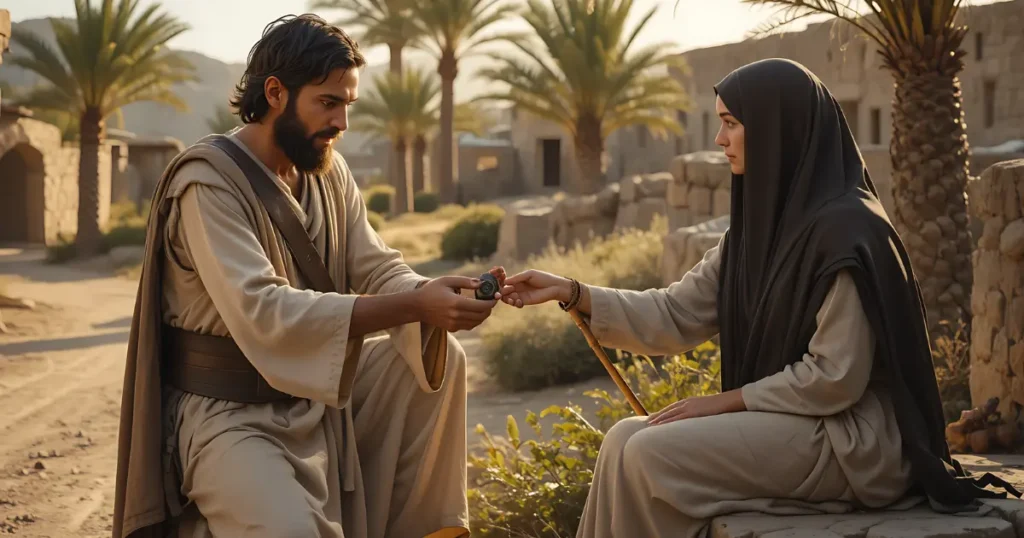
She removed her widow’s clothing, covered herself with a veil, and sat along the road where Judah would pass. Judah saw her and thought she was a harlot, so he went in unto her.
The account of Judah and Tamar often raises difficult questions for modern readers. But the story makes it clear that Tamar acted only after Judah failed to offer the justice and safety that was her due under the family custom.
Before agreeing to Judah’s proposal, Tamar requested a pledge until payment could be delivered.
She asked for three personal items:
- His signet
- His cord
- His staff
These objects functioned much like a modern signature, identification card, and legal seal combined. They singled out Judah and later confirmed his identity.
The mention of the signet, cord, and staff is one of the most important details in Genesis 38. Tamar gathered evidence that later proved the truth, and she was prudent to do so.
Several months later, Judah learned that Tamar was pregnant. Not knowing his involvement, he demanded punishment for what appeared to be immoral behavior.
At that moment, Tamar presented the items he had left with her.
Genesis 38:26 records Judah’s response:
“She is more righteous than I, since I wouldn’t give her to my son Shelah.”
This story is the crux of the story of Judah and Tamar in the Bible. Judah publicly confessed his sin and accepted that Tamar had been wronged.
According to the Jewish Women’s Archive, many Jewish interpreters have viewed Tamar as a determined woman who acted to preserve Judah’s family line when others failed to fulfill their responsibilities. Her story is one of personal heroism and of the need to preserve the covenantal lineage.
The account concludes with the birth of Tamar’s twin sons.
During labor, one child briefly extended his hand, and a scarlet thread was tied around it to mark the firstborn. But the child drew back his hand, and his brother led the way.
The twins were named Perez and Zerah.
The story of the twins Perez and Zerah may seem like a minor detail, but it carries enormous significance. Perez was the forefather of Boaz, King David, and Jesus Christ.
When readers study Perez and Tamar in the Bible, they find that Tamar’s account directly connects to God’s plan of redemption. The story of loss, injustice, and uncertainty became part of the Messianic lineage that would bless the world.
This ending reminds us that God often works through broken circumstances and imperfect people. The same God who remembered Tamar’s situation used her place in history to protect the line through which the Savior would arrive.
Like Jezebel, Leah, Lydia, and Abigail, Tamar’s life stands as a unique testimony within Scripture. Yet her story is especially powerful because it shows how God’s purposes can move forward even when human beings fail in their responsibilities.
Why Did Judah Say Tamar Was More Righteous Than He?
One of the most surprising moments in Genesis 38 comes when Judah declares:
“She is more righteous than I, since I wouldn’t give her to my son Shelah.” (Genesis 38:26, NIV)
At first glance, this information can be confusing. For Tamar disguised herself and misled Judah. But why did Judah say in public that Tamar had been righteous?
The key is understanding what was happening behind the story’s events.
Judah had promised Tamar that he would give her to his youngest son, Shelah, when he came of age. This pledge was linked to keeping the family line alive, to giving Tamar the protection and future she was entitled to. Yet Judah never intended to keep his word.
Tamar, meanwhile, had been left in an impossible position. She was a widow without children, unable to move forward with her life, and denied the family rights that should have been hers. When she learned that Judah had betrayed his commitment, she took steps to preserve the family line.
This is why Judah’s confession matters so much. He was not claiming that every action Tamar took was perfect. Rather, he was admitting that he had failed in his covenant responsibility while Tamar had acted to preserve what he had neglected.
This passage also teaches an important lesson about righteousness in the Bible. In Scripture, righteousness often refers to acting rightly in one’s relationships with God and others. It is not merely about outward appearances. It entails faithfulness, justice, honesty, and the performance of duties.
In Genesis 38, Judah recognized that he had violated those responsibilities. Tamar’s actions exposed his failure and forced him to confront the truth.
Many people misunderstand this verse by assuming it means Tamar was completely sinless or that the Bible is approving deception. The text permits neither conclusion. The focus is on Judah’s failure to protect Tamar and preserve the family line, not on presenting every decision Tamar made as an ideal example.
Instead, Genesis 38 highlights Tamar’s righteousness in contrast to Judah’s neglect. The story suggests biblical justice, accountability, and covenant loyalty. It reminds us that God sees beyond public appearances and cares deeply about how people treat the vulnerable.
Like Abishag, Anna, Apphia, and Abital, Tamar’s story reveals that women often played significant roles in God’s purposes, even when their circumstances were difficult or misunderstood. Her account continues to challenge readers to consider what true righteousness looks like when justice and responsibility are at stake.
Why Is Tamar Important?

Many readers ask, “Why is Tamar important in the Bible?” The answer goes far beyond the events of Genesis 38. Tamar’s account is significant because it connects family history, covenant promises, and God’s plan of redemption. Among the many women in Scripture, her life shows how God can accomplish His purposes through unexpected circumstances. Like other notable female Bible characters, Tamar’s influence reaches far beyond her own generation.
Tamar Preserved Judah’s Family Line
One reason Tamar matters is her role in preserving the line of Judah.
When Er and Onan died without heirs, Judah’s family line faced a serious threat. In the ancient world, people needed children to ensure the continuation of inheritance, family identity, and future generations. Without an heir, a branch of the family could face extinction.
Through the birth of Perez and Zerah, Tamar helped preserve the covenant family line that God was using in His unfolding plan. What began as a family dilemma turned into a catastrophe that would impact the future history of Israel.
If Tamar had not been so persistent, the line from Judah may have gone in a very different direction.
Tamar’s Place in Salvation History
Another reason for Tamar’s significance is her place in salvation history.
The Bible often shows God at work, even when people cannot see it. This episode is a clear instance of God’s providence.
Perez, Tamar’s son, became an ancestor of King David. Generations later, the Gospel of Matthew includes Tamar in the genealogy of Jesus Christ (Matthew 1:3).
This means Tamar’s story is not simply about one woman overcoming hardship. It is part of the larger biblical story that leads to the promised Messiah. Her inclusion in Jesus’ family line reminds readers that God’s plans often move forward through unexpected people and circumstances.
God’s Work Through Imperfect People
Tamar’s story also highlights a theme found throughout Scripture: redemption through imperfect people.
Genesis 38 does not present a perfect family. Judah made some serious blunders. Tamar had hard decisions to make. Yet human failure did not stop God’s purposes.
Instead, the account demonstrates how God works through flawed people to accomplish His will. This reality is reiterated throughout the Bible and brings hope to believers today.
Like Ahinoam, Adah, Aholibamah, and Atarah, Tamar played a role in God’s unfolding story. Her life reminds us that God’s faithfulness often outweighs human weakness, and His plans can move forward even in situations marked by failure, loss, and uncertainty.
Tamar in Jesus’ Genealogy
One of the most remarkable parts of Tamar’s story is that it does not end in Genesis 38. Her name appears again centuries later in the opening chapter of Matthew’s Gospel. Tamar’s involvement in Jesus’ genealogy means her narrative wasn’t a side note in biblical history.
It was a part of God’s wider redemptive plan. Among the many stories of Bible women, Tamar’s account stands out because she is one of only a few women specifically named in the family record leading to Jesus Christ.
Why Is Tamar Mentioned in Matthew 1?
Many readers wonder, “Why is Tamar in Matthew 1?
According to Matthew 1:3,
“Judah the father of Perez and Zerah, whose mother was Tamar…”
In ancient genealogies, women were rarely mentioned. Yet Matthew intentionally includes Tamar, Rahab, Ruth, and the wife of Uriah before arriving at Mary, the mother of Jesus.
The inclusion of women in Jesus’ genealogy highlights important truths about God’s work throughout history. Each of these women had peculiar circumstances surrounding her story, but God used them to advance His promises.
Tamar’s presence in the genealogy reminds readers that God sees value where society may overlook it. She was once a vulnerable widow whose future seemed uncertain. But God protected her place in the line of the covenant and made sure that her name would not be forgotten.
BibleProject notes that biblical genealogies are not merely family records. They help readers trace God’s promises through generations and show how His purposes unfold throughout history. In other words, genealogies tell a story, not just a list of names.
This passage helps explain why Matthew deliberately included Tamar in the opening chapter of his Gospel.
Perez and the Messianic Line
One of the most notable effects of Genesis 38 was the birth of Perez.
Perez is mentioned repeatedly throughout Scripture because he became an ancestor of Jesus. His descendants included Boaz, Obed, Jesse, King David, and finally Jesus Christ.
This means Tamar’s son played a direct role in the Messianic lineage.
What appeared to be a family crisis in Genesis became part of God’s plan to bring salvation to the world. The covenant promises to Abraham were passed on through Judah’s line, with Perez as one link in the chain.
Without Perez, the biblical genealogy would look very different.
What Tamar’s Inclusion Reveals About Grace
The story of Tamar in Jesus’ genealogy also teaches an important lesson about grace in the Old Testament.
Tamar’s family situation was complicated. Judah failed in his responsibilities. The circumstances surrounding Perez’s birth were not ideal. But God did not forsake His purposes.
Instead, the story points toward biblical redemption, the truth that God can bring good out of broken situations and work through imperfect people.
Tamar’s inclusion in the genealogy does not celebrate human failure. It is a celebration of God’s faithfulness.
Her account reminds readers that God’s grace has been present throughout Scripture, long before the birth of Christ. In the same way that God worked through Tamar’s life, He continued to work through the generations until the promised Savior arrived.
Like the stories of Athaliah, Mary, Mary Magdalene, and Mary of Bethany, Tamar’s story shows that women played important roles in God’s unfolding plan. Yet her place in the genealogy of Jesus gives her a unique position in the biblical narrative, connecting Genesis directly to the coming of Christ.
Timeline of Tamar’s Life
Understanding the history of Tamar in the Bible is easier when we view the major events in chronological order. Although Genesis 38 covers a relatively short period, the events in Tamar’s life had lasting consequences for Israel’s history and the genealogy of Jesus Christ.
| Event | What Happened |
|---|---|
| Tamar Marries Er | Tamar entered Judah’s family when she married Er, Judah’s firstborn son (Genesis 38:6). |
| Death of Er | Er was judged by God for his wickedness and died without leaving an heir, making Tamar a widow (Genesis 38:7). |
| Death of Onan | Following family custom, Onan was expected to provide offspring for his deceased brother’s line. He refused and was also judged by God (Genesis 38:8 to 10). |
| Waiting for Shelah | Judah promised that Tamar would marry his youngest son, Shelah, when he became old enough. Tamar returned to her father’s home and waited (Genesis 38:11). |
| Judah Breaks His Promise | Years passed, but Judah never gave Shelah to Tamar, leaving her without security or a future heir. |
| Encounter With Judah | Tamar disguised herself and met Judah on the road to Timnah. She secured his signet, cord, and staff as a pledge (Genesis 38:13 to 18). |
| Judah’s Confession | When Tamar’s pregnancy became known, Judah recognized his belongings and admitted, “She is more righteous than I” (Genesis 38:26). |
| Birth of Perez and Zerah | Tamar gave birth to twin sons, Perez and Zerah, preserving Judah’s family line (Genesis 38:27 to 30). |
| Genealogical Legacy | Perez became an ancestor of King David and later Jesus Christ, giving Tamar a permanent place in biblical history (Matthew 1:3). |
Tamar’s life moved from loss and uncertainty to a lasting legacy within God’s redemptive plan. Like the stories of Martha, Miriam, Naomi, and Priscilla, her story reminds readers that God often works through ordinary people facing difficult circumstances. What was a private struggle became a turning point in salvation history.
Lessons From Tamar’s Life
The story of Tamar is more than a historical record. It offers practical insights that still speak to believers today. The lessons from Tamar in the Bible are not always comfortable, but they reveal important truths about God’s character, human responsibility, and the way God works through difficult circumstances. These biblical lessons from Tamar help us see that even complicated stories can point us toward faith, hope, and God’s faithfulness.
God Sees the Forgotten
For much of Genesis 38, everyone around Tamar seems to overlook her.
She lost her husband. She lost the opportunity to have children through Onan. And she waited for years while Judah broke his vow concerning Shelah. From a human perspective, Tamar had little power and few options.
Yet God saw her situation.
The Scripture never records God speaking directly to Tamar, but the story’s outcome implies that He was not oblivious to her suffering. Judah’s public confession eventually brought her vindication, and her place in the family line was restored.
Many believers can identify with the times they feel neglected, forgotten, or mistreated. Tamar’s narrative tells us that God sees what others cannot see. His timing may not match our expectations, but His justice is never absent.
Faithfulness Matters Even in Difficult Circumstances
Tamar’s life was marked by uncertainty. She faced repeated disappointments and long waits.
Despite those hardships, she remained connected to Judah’s family and continued to seek the future God had promised her. Her story highlights the importance of perseverance when circumstances seem unfair or confusing.
Faithfulness is often tested not during easy seasons but during difficult ones.
Many people in Scripture experienced long waits before seeing God’s purposes unfold. Tamar joins a long list of believers who faced obstacles without knowing how their stories would end.
Her example encourages Christians to remain loyal even when answers are delayed. There are many times when God works in ways we don’t yet see.
God Can Bring Redemption From Broken Situations
Genesis 38 is not a story about a perfect family making perfect decisions. It is a story filled with grief, failure, broken promises, and human weakness.
Yet God did not abandon His purposes.
Instead, He brought biblical restoration out of circumstances that appeared hopeless. Finally, Tamar’s story became part of the lineage that led to King David and Jesus Christ.
This is one of the clearest examples of the Old Testament’s biblical themes of redemption. God didn’t erase the blunders from the story. He took them through it.
That truth remains encouraging today. People often assume that broken relationships, painful experiences, or past failures have ruined God’s plans for their lives. Tamar’s story shows a different outcome.
The God of Scripture specializes in bringing hope from hardship and purpose from pain. While redemption does not always happen as we expect, God can bring good from situations that seem hopeless.
Like the stories of Phoebe, Rachel, Rahab, and Rebekah, Tamar’s story reminds us that God’s faithfulness is greater than human weakness. Her life stands as a testimony that God’s plans can move forward even when circumstances seem messy, uncertain, or broken.
Frequently Asked Questions about Tamar
Q1: Was Tamar a Canaanite?
The Bible never directly states Tamar’s ethnicity. However, many scholars believe she may have been a Canaanite because she married into Judah’s family while they were living among the Canaanites. The information provided in Scripture is not sufficient to be sure.
Q2: Did Judah marry Tamar?
Many readers ask, “Did Judah marry Tamar in the Bible?”
No, Judah did not marry Tamar. Tamar was first married to Judah’s son Er. After the death of Er and then Onan, Judah promised Tamar that his youngest son, Shelah, would marry her when he grew up. The promise never materialized. Tamar later became pregnant by Judah through the events recorded in Genesis 38, but they were never described as husband and wife.
Q3: How many women named Tamar are in the Scriptures?
If you’re wondering how many Tamars there are in the Bible, the answer is three.
Tamar, the daughter in law of Judah (Genesis 38).
Tamar, the daughter of King David, was mistreated by her half-brother Amnon (2 Samuel 13).
Tamar, the daughter of Absalom (2 Samuel 14:27).
The Tamar addressed in this article is the first Tamar, the woman in Genesis 38.
Q4: Why did Tamar keep Judah’s signet, cord, and staff?
Tamar requested Judah’s signet, cord, and staff as a pledge until he could send the promised payment. These were personal identification items. They were unique to Judah and functioned much like legal proof of identity. Later, when Judah accused Tamar of sin, she proved that he was the father of her unborn children by producing these objects. With them, she had no way of proving the truth.
Q5: What does Tamar’s story teach about waiting on God?
Tamar’s story shows that waiting can be painful and confusing. She waited for years for Judah to fulfill his promise to Shelah, but it was always delayed. While Genesis 38 is not primarily a lesson about patience, it reminds believers that God sees situations others have forgotten. God’s plan is not defeated when men fail. Tamar’s story encourages Christians to trust God’s justice and faithfulness during seasons of uncertainty.
Q6: Why is Tamar one of the few women named in Jesus’ genealogy?
Matthew intentionally included Tamar in the genealogy of Jesus (Matthew 1:3).
Her inclusion highlights God’s faithfulness throughout history and shows how He worked through unexpected people to accomplish His plan of salvation. Tamar helped preserve Judah’s family line through the birth of Perez, who became an ancestor of King David and Jesus Christ. Her presence in the genealogy reminds readers that God’s grace and redemptive aims weave throughout the entire biblical story.
Conclusion of Tamar’s Story
So, who was Tamar in the Bible?
She was a widow who faced loss, uncertainty, and injustice, yet her story became part of one of the most important family lines in Scripture. The story of Tamar in the Bible is not just a tough situation between Judah and Tamar. It is a story about covenant promises, family responsibility, and God’s faithfulness working through imperfect circumstances.
As we’ve seen, Tamar entered Judah’s family through marriage, endured the deaths of Er and Onan, waited for a promise that was never fulfilled, and ultimately became the mother of Perez and Zerah. Through Perez, her line extended to succeeding generations, finally reaching King David and Jesus Christ.
That connection is one reason Tamar remains such a significant figure among the many women in Scripture. Her name belongs in Matthew’s genealogy because her story is part of the broader narrative of redemption woven throughout the Bible.
Tamar’s life does not fit neatly into simple categories. Her account raises difficult questions, yet it also reveals important truths about justice, perseverance, responsibility, and God’s providence. God’s purposes persist even when individuals fail.
Her story reminds us that seemingly forgotten individuals can have a lasting place in God’s plan and that redemption often emerges from unexpected circumstances.
If you enjoyed this study, be sure to read more posts from our Women of the Bible series, where we explore the lives, struggles, faith, and lasting impact of the remarkable women found throughout Scripture.